
For years, my professional bio read like a standard trajectory in academia and systemic reform. It spoke of a theoretical mathematician, a veteran educator, and an instructional technology manager dedicated to fixing fractured learning models. It highlighted a belief in hands-on, pen-to-paper learning and the creation of alternative frameworks to rescue students from the isolating abyss of digital over-saturation.
But resumes lie by omission. They smooth over the raw, terrifying human realities that actually drive our most pivotal choices.
The truth is, I didn’t take the job teaching mathematics at Poinciana High School because of a career plan. I didn’t do it to build a resume or pilot a new curriculum.
I did it because of a deeply moving, late-May email from Dr. William Dodson, carrying a subject line that still makes my throat tighten: “Re: The attempt at Jaden saying good bye.”
The Back Pocket Lifeline
When you teach neurodivergent students—specifically those carrying the dual weight of severe ADHD and profound childhood trauma—the job description changes. You cease to be just an instructor delivering content; you become a human anchor. For Jaden, I had become that anchor.
But K-12 education is a conveyor belt. As students approach their senior year, the system prepares to push them off the edge into an adult world entirely unequipped to catch them. The structural safety nets—the IEPs, the 504 plans, the daily check-ins—abruptly vanish. I was terrified of the handoff because I knew there was no one standing on the other side of the track to catch the baton.
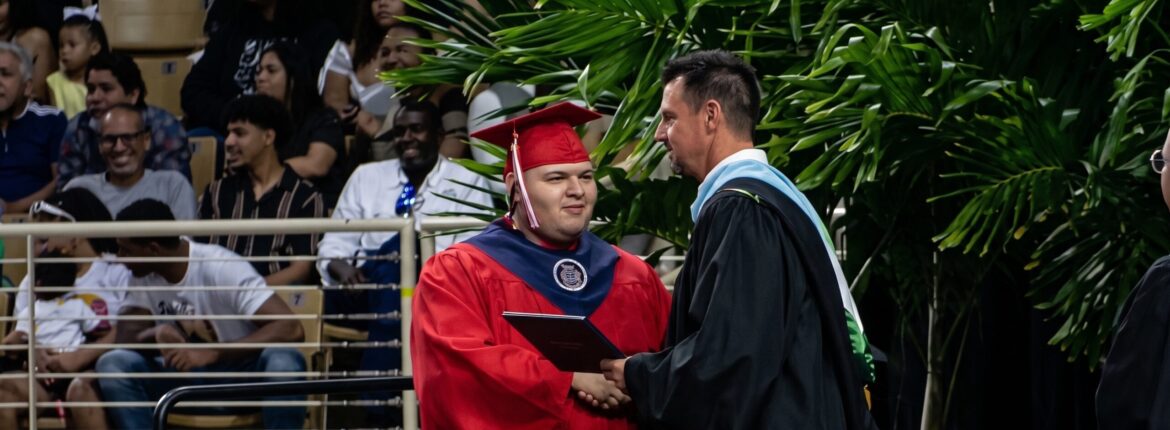
When it came time to part ways, there was no massive explosion or sudden crisis; it was simply Jaden experiencing a profound, quiet struggle just to get the words out in a goodbye. Seeing that raw difficulty, Dr. Dodson sent me the words that would dictate my next move:
"A bittersweet parting. You have prepared him but it wouldn't hurt to have you in his back pocket for a few more years. You'll hear from him again."
That was the real catalyst. I went to Poinciana High School to stay close. I went to ensure that when the ground shook beneath a former student who had already survived too much, a stable, trusted adult was within arm's reach. I became the safety net,in case he needed one, because the system refused to build one.
Exposing the Gap: Teaching the Teachers
While my mission began with a single student, my time at Poinciana ultimately exposed the massive, structural chasm that exists in teacher preparation.
One of the definitive reasons I eventually left Poinciana was sparked by a realization I had while fulfilling professional development mandates. I took the standard ESOL (English for Speakers of Other Languages) courses designed to help teachers better serve their English Language Learner (ELL) students. As I sat through the training, a glaring question hit me: We have comprehensive frameworks like this for ELL students, and districts provide specialized classes for Autism Spectrum Disorder (ASD) students—so why isn't there an equivalent for ADHDers?
This question blew wide open the hidden systemic gap. It illuminated exactly why so many educators either didn’t want to, or simply lacked the fundamental tools to, empathetically connect with ADHD students—especially those carrying significant trauma.
Just as Dr. Dodson recognized a void in medical education and crafted the very first ADHD textbook for adult psychiatric residency programs, I realized that the exact same revolution is desperately needed in K-12 education. We need a definitive framework to teach the teachers how to handle the neurological and emotional realities of these kids.
The Escape Room and the Safe Room
Because that framework doesn't yet exist, the systemic failures Dr. Dodson warned me about manifested daily in the hallways. Due to the rigid, compliance-driven approaches of several of my fellow teachers who lacked those tools, I watched completely overwhelmed math students get trapped in an anxiety-inducing, high-stakes academic "escape room." For a student already battling neurodivergence and trauma, a classroom like that isn't an environment for learning—it's a psychological trigger.
Fortunately, I wasn't the only one fighting to alter the environment. The amazing social worker, Ms. Fundora, recognized exactly what these students were enduring. She began having those traumatized, hyper-anxious students transferred directly out of those high-stress situations and into my math classroom. Together, we turned my room into a designated safe room where they could drop their armor, catch their breath, and actually learn.
The Invisible Battle: The Planning Regret
Yet, fighting to maintain a sanctuary for traumatized kids while battling your own systemic hurdles is an exhausting tightrope walk. If I am confessing everything, I have to own my own shortcomings alongside the systemic ones.
I have a major professional hurdle: due to PTSD, I have a profoundly difficult time focusing when I am in the place where I sleep. For me, doing deep, focused cognitive work requires being physically away from home. At my previous charter school, I was able to manage this boundary perfectly; I could go into the building on weekends to meticulously plan out my entire week.
But large school districts operate on rigid regulations. At Poinciana, district rules cut off that weekend access. Suddenly, the physical environment I required to plan effectively was stripped away. Left without a dedicated space away from home to map out my curriculum, I struggled to adapt my workflow. I missed the mark with my lesson planning, and it remains a deep regret of mine that I did not fully meet the moment for my classes in that regard.
Witnessing a Master Craft
Despite my own internal struggles, I was anchoring myself to an administrator who understood the sheer weight of what we were managing. When I arrived at Poinciana High School, I already thought the Principal would be terrific. Jeffrey Schwartz not only did not disappoint, but of the three rock-star principals I have had the pleasure to work with over my career, he edges them out slightly to take the top spot as the absolute GOAT (Greatest of All Time).
Managing a Title I high school with approximately 2,600 students is a monumental task, but Principal Schwartz channels his OCD precisely into managing the exact tone of the building. He is a genuine mastermind at making his high school as safe a place as possible, while simultaneously ensuring that everyone graduates.
Dr. Dodson’s email had explicitly warned me that I would need to find a "world-class administrator who has signed onto the vision"—someone to handle the administrative architecture because my strengths lie elsewhere. In Schwartz, I found exactly that. He will move heaven and earth to make sure a kid with severe trauma gets exactly what they need to graduate. Working under his leadership, I was incredibly lucky to see a true master flow in his craft, orchestrating the exact environment Dr. Dodson told me I needed to find.
De-escalating the Invisible Crisis: The Geometry Student
Thanks to Mr. Schwartz, I was given the privilege of helping another senior who had been completely written off. This was an ADHD student with severe childhood trauma and undiagnosed Rejection Sensitive Dysphoria (RSD)—a combination so intense that no one in the building had been able to connect with him. The system had already given up on finding a classroom fit; the school had gone through two different geometry teachers trying to find a placement before they finally settled the task on me.
His chart was full of documented "episodes," but the system didn't understand the why. Working alongside our fabulous counselor, Donald Petrella, I was able to help decode the behavior. I helped Donald understand that these outbursts weren't random defiance; they were severe RSD reactions triggered almost entirely by the condescending, weaponized tone of an untrained paraprofessional.
Once we understood the trigger, we changed the ecosystem around him. In the end, Principal Schwartz, Donald Petrella, Ms. Fundora, and myself became a united front—this student's designated safe places. He could still be bullied out in the world, but within our circle of safety, he rarely had another episode. He didn't just survive; Jeffrey Schwartz made sure he graduated.
The Payoff: A Breeze of Fresh Air
When you pass the baton into a void, you spend nights lying awake wondering if the kid you shielded fell straight through the cracks. But sometimes, the universe sends you proof that the scaffold held.
Not long after graduating and transitioning into trade school, that same geometry student reached out to me. His words are the ultimate answer to why we do this work:
"It's been a breeze of fresh air," he wrote. "I've made friends that don't treat me like disposable waste. I'm being myself my true self even when I thought that version of me was gone forever, and you helped get me there, and it's amazing how I thought I was going to continue getting bullied for the rest of my life you gave me the most important thing a human HOPE... You truly have my sincerest of gratitude for helping this broken man become whole again. I will never forget what you did for me."
He went on to tell me about his new friends, a group chat they already started named Godzilla Mode, and how passing math was the gatekeeper that allowed him to get there.
That text message is the real report card. It wasn't about the algebra or the geometric proofs; it was about protecting a human soul long enough for them to realize they are valued, to see themselves in a different light, and to find the confidence to step into the world as a whole person.
Yet, the anxiety of the "handoff" doesn't always resolve with an institutional program. Sometimes, it resolves where it should have all along: with the family. When I finally met this student's mom that summer, a wave of relief hit me. I realized that, in his case, she was firmly step-by-step taking care of things. The baton hadn't been dropped or passed into a void; it had already been safely handed off to her.
Searching for an Environment That Doesn't Exist
The second half of Bill’s email contained a heavier, more daunting mandate—one that goes to the heart of why so many passionate educators find themselves entirely exhausted:
"You and the two other teachers who are leaving are looking for a working environment that does not yet exist. You have got to create it and then teach others what you've discovered. Go out and change the world. Be sure to get a world class administrator who has signed onto the vision. Your strong points do not include administration... farm it out to another true believer."
Dr. Dodson diagnosed the systemic crisis perfectly. The reason educators who care about trauma and neurodivergence feel so profoundly isolated is that we are trying to play a role that isn't built into the standard institutional architecture. The system often demands rigid compliance, metrics, lock-out times, and administrative checklists over human connection and the specific needs of the staff trying to save these kids.
By moving to Poinciana, I wasn't just tracking a student; I was trying to survive within a broken framework while actively dreaming of a better one. I was learning firsthand the exact gaps that exist between a traumatized student's reality and the rigid expectations of secondary education. But with allies like Ms. Fundora, Donald Petrella, and a leader like Schwartz, I saw proof that an administrator and a dedicated team can build a shield for these kids.
The Handoff
This is my confession, but it is also an indictment.
No single teacher should have to alter their life path just to ensure a vulnerable student has a "back pocket" lifeline. No educator should have to fight district regulations just to find a safe space to plan lessons for their students. No educator should have to be the entire infrastructure themselves.
We are losing incredible teachers because they are being forced to create environments that do not yet exist, entirely from scratch, without administrative or structural cover. We are watching seniors step up to the graduation stage not with a sense of triumph, but with a sense of dread, because they know the world outside the school walls is fragmented and cold.
I went to Poinciana for Jaden. But I am writing this, and building an advocacy platform, for every junior and/or senior currently standing on that ledge. It is time to stop looking for a single runner to hand the baton to, and start building the community scaffolding, utilizing the safe spaces, and finding the master leaders required to help these students carry it themselves.