
When we think about early childhood athletic programs, we usually frame them around physical health, teamwork, or letting kids blow off steam. But if you watch astrophysicist Neil deGrasse Tyson talk about how children actually learn, you realize that play isn't a break from education—it is the highest form of science a child can perform.
Tyson famously argues that adults put an immense amount of energy into squashing a child's natural curiosity [00:22]. We tell them not to touch things, not to make a mess, and to step around the muddy puddles [01:59]. In doing so, we extinguish the very experiments that teach them how forces, fluids, and reality function. As Tyson puts it: "What is an adult scientist but a kid who's never lost the curiosity?" [02:52].
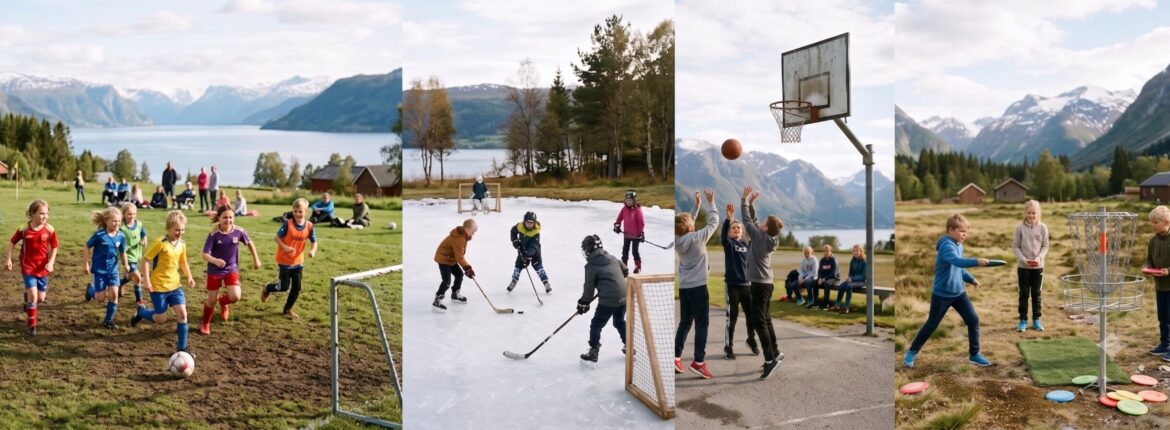
This is where Norway’s revolutionary Idrettsglede ("the joy of sport") framework transforms from an athletic policy into a profound scientific sanctuary. By banning public rankings, official standings, and hyper-competitive scorekeeping for children under the age of twelve, Norway has effectively institutionalized Tyson’s core philosophy on a national scale. They have realized that to protect curiosity, you have to allow for chaos.
The Muddy Puddle Theory of Sports
In his discussion, Tyson recalls seeing a toddler in a raincoat and galoshes approach a "big juicy muddy puddle" in Central Park [01:40]. The mother instantly yanks the child away to keep them clean, missing the fact that the child was about to run a fluid dynamics and cratering experiment [02:06].
Traditional, hyper-competitive youth sports are the institutional equivalent of that mother pulling the child away from the puddle. When we introduce intense adult metrics—point spreads, travel team cuts, and state rankings—at age eight or nine, we alter the physics of the playground:
- In a High-Stakes System: A mistake is a social and emotional catastrophe. Dropping a ball or missing a goal means losing points, letting down parents, or being benched. The environment becomes hyper-sterile. Children stop experimenting because the cost of failure is too high.
- In the Norwegian System: Because there are no official scoreboards or rankings, a mistake reverts to being what Tyson calls a pure experiment. If a child tries a wild, unpracticed kick and misses, the water just splashes. They observe the cause and effect of a downward force without the crushing weight of public shame [02:13].
By removing the scoreboard, Norway prevents adults from squashing the natural, exploratory drive that turns movement into deep cognitive data.
[Adult-Driven Sports]  --> Focus on Scoreboards --> Fear of Failure --> Stifled Exploration
[Norway's Ecosystem]   --> Focus on Pure Play   --> Safe to Fail     --> Scientific Curiosity
Neurodivergence and the Freedom to Experiment
This freedom to experiment without judgment is a massive lifeline for neurodivergent children. A child with ADHD, autism, or developmental coordination differences already experiences an environment that feels chaotic or heavily managed by anxious adults.
When these children are thrown into traditional sports systems, the pressure to conform and perform perfectly on a scoreboard is immense. They are frequently penalized for coloring outside the lines of standard athletic execution.
Norway’s model transforms the athletic field into a low-stakes laboratory. For a neurodivergent brain, unstructured and unranked play provides the exact "extra work" and messy grace Tyson advocates for [02:31]. It allows a child to test their own physical boundaries, experiment with spatial mechanics, and learn peer-to-peer social dynamics at a pace dictated by their own nervous system, not an adult's tournament schedule.
The Clean House Fallacy
Tyson notes that you don't raise children with the goal of keeping a clean house—kids are naturally engines of disorder because everything in the universe is a brand-new experiment to them [01:01]. Similarly, Norway realizes you don't run youth sports to maintain clean, orderly spreadsheets of child rankings. You run them to keep the flame of active, messy discovery burning.
Protecting the Inner Scientist
Norway’s athletic blueprint up to age twelve proves a stunningly counterintuitive point: if you want elite, resilient, and highly creative adults, you have to tolerate the chaos of childhood.
By legally protecting a child’s right to play without the anxiety of adult metrics, Norway ensures that the turbulent early years don't extinguish their internal drive to explore. They have built an entire culture around the understanding that a child jumping unranked into a game, or a toddler splashing unapologetically into a muddy puddle, isn't wasting time. They are doing the fundamental work of learning how to change the world.
YouTube video views will be stored in your YouTube History, and your data will be stored and used by YouTube according to its Terms of Service