
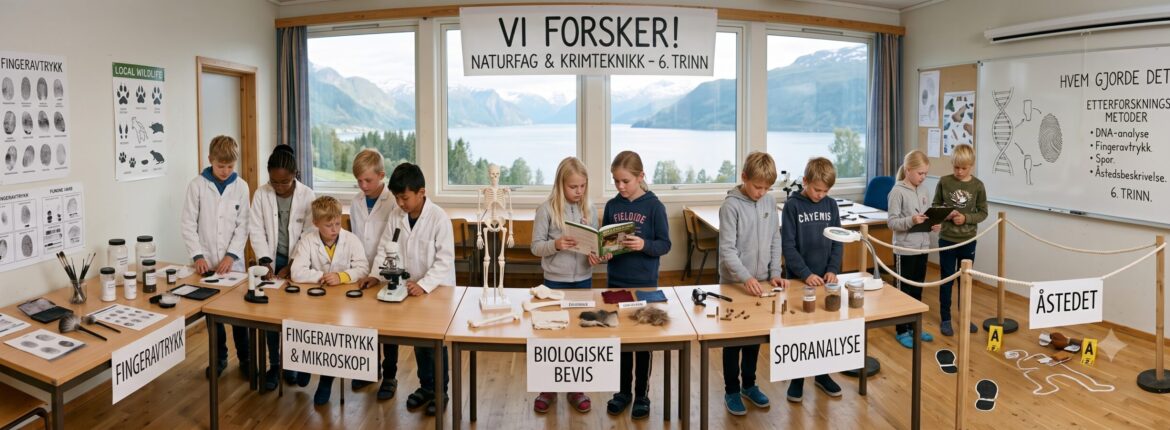
If you want to see what Norway’s national educational policies look like when translated into a single, concrete curriculum, you don’t look at a standard textbook. You look at an interactive, investigative model like a "CSI Geology"classroom.
Norway’s systemic push to ban generative AI in primary grades and eliminate high-stakes, outcome-based pressure isn't just about stepping back from screens. It is about stepping into active, multidisciplinary exploration. A forensics-style geology class—where students treat earth sciences, rock formations, and volcanic evidence as a physical crime scene to be solved—is the perfect tactical execution of exactly what Norway is trying to protect.
Here is why a "CSI Geology" model perfectly mirrors the neurological and pedagogical goals of the Norwegian educational blueprint.
1. It Reclaims the Sensorimotor Loop (The Hawkins Model)
As established by Jeff Hawkins's Thousand Brains Theory, the neocortex requires physical interaction and spatial reference frames to form stable abstract concepts.
In a traditional classroom, geology or earth science is often taught through flat memorization: students stare at a diagram of a volcano or label the rock cycle on a worksheet. In an AI-diluted classroom, it gets worse—a student prompts an LLM to explain plate tectonics, receiving a tidy text summary that their brain completely forgets ten minutes later because no physical coordinate maps were constructed.
[Passive Learning]    --> Text/Screen Readout   --> Weak Spatial Mapping  --> Quick Cognitive Decay
[CSI Geology Model]   --> Tactile Investigation --> Sensorimotor Loop     --> High-Resolution Concept
A "CSI Geology" class forces the sensorimotor loop back open. Students are handed physical, tactile evidence:
- They physically handle an igneous rock, feeling its rough, vesicular pores to deduce its volcanic origin.
- They use physical grid coordinates on a classroom floor map to track seismic data or volcanic fallout.
- They write down physical, pen-to-paper inferences, physically cross-referencing clues across their desk.
By treating geology as a physical puzzle, the class feeds the cortical columns the exact tactile, spatial data needed to map complex, multi-dimensional scientific concepts.
2. It Replaces Scoreboards with Pure Narrative Curiosity
The core of Norway's youth philosophy (Idrettsglede) is that removing high-stakes, adult-driven metrics (like scoreboards and public rankings) lowers performance anxiety and creates a safe sandbox for deep learning.
Standard science education is plagued by the "academic scoreboard"—rote tests, flashcard memorization, and competitive grading systems where getting the "wrong answer" carries a heavy penalty. This environment triggers stress, stalling a child's natural drive to explore.
A "CSI Geology" framework completely subverts this by replacing the scoreboard with a narrative mystery.
- The Shift: Instead of asking, "Can you memorize the definition of an explosive caldera?" the class asks, "Based on this ash layer and rock density, can you tell us what happened at this site 10,000 years ago?"
- The Result: The shift from testing to investigating mirrors Neil deGrasse Tyson's philosophy of treating childhood as a laboratory of chaos. If a student makes an incorrect inference about a rock sample, it isn't an academic failure that lowers their standing; it is simply a failed experiment. They re-examine the physical evidence, run another inference, and adjust their internal map.
3. A Sanctuary for the Neurodivergent Brain
Norway's inclusive, unranked framework is explicitly designed to support childhood neurodivergence by allowing kids to interact with their environment at their own organic pace.
Rigid, screen-based, or lecture-heavy math and science classes are notoriously punishing for neurodivergent minds. A student with ADHD or executive functioning differences may struggle to maintain focus on a flat tablet screen or a linear, dry lecture.
A multidisciplinary "CSI Geology" class serves as an absolute sanctuary for these learners because it is inherently kinetic and multi-sensory.
| Traditional Science Class | "CSI Geology" Sandbox | Neurodivergent Alignment |
| Single-mode (Reading text/listening) | Multi-modal (Touching rocks, mapping space, debating clues) | High sensory engagement keeps the ADHD brain naturally locked-in |
| Linear, rigid speed requirements | Non-linear, investigative problem-solving | Allows for autonomous, organic pacing and independent logic leaps |
| Outcomes-first (The correct test answer) | Process-first (Building the case file) | Lowers executive functioning anxiety; mistakes are just data points |
By turning a science lesson into a hands-on, high-dimensional investigation, you remove the artificial barriers of the traditional classroom. The neurodivergent mind is suddenly free to do what it does best: spot non-linear patterns, think outside the established box, and build an authentic, lived understanding of how the world works.
Reengineering the Human Edge
Ultimately, the alignment between a "CSI Geology" curriculum and the Norwegian model comes down to a fundamental belief about human intelligence: we are built to discover, not to consume.
By rejecting the passive shortcuts of classroom AI and building learning environments centered on real-world, tactile, and collaborative mystery, we protect the formative years. We ensure that our kids don't just learn to read definitions of the world—they learn how to actively read the world itself.