
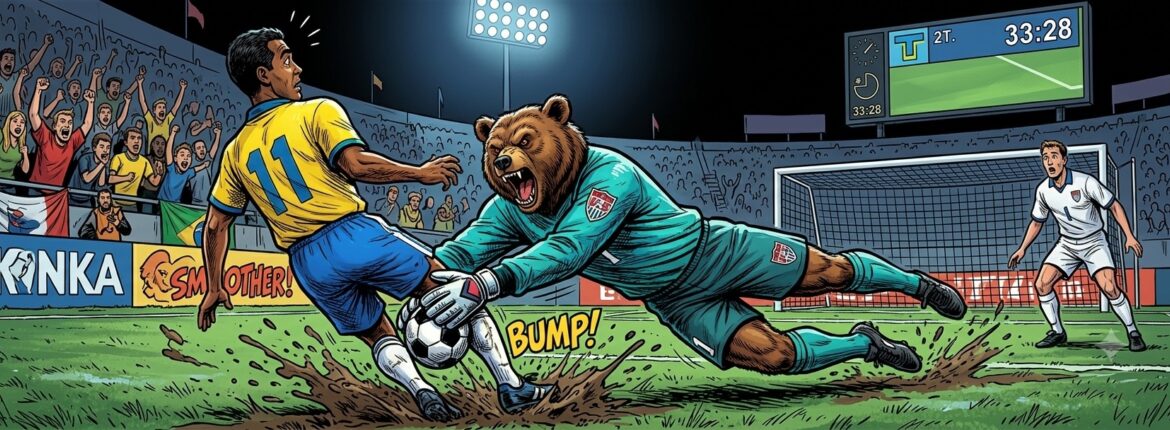
To the uninitiated, when a goalkeeper like Kasey Keller or Emiliano “Dibu” Martínez hurtles off their line to throw their physical frame directly at a charging striker's laces, it looks like reckless bravado—a hyper-aggressive, alpha-male display of dominance.
But that is a profound misreading of the competitive instinct.
This brand of extreme, forward-charging goalkeeping isn't an alpha-male power trip. It is a primal, "mama bear" intervention. It is the absolute, unyielding willingness to completely sacrifice one’s own physical body to shield and defend the team behind them. For the non-linear, empathic competitor, this fierce protective instinct acts as the ultimate neural lens, transforming an overwhelming, high-stress scenario into a moment of razor-sharp, hyper-focused execution.
By examining three iconic modern keepers through this tactical case study, we can see exactly how this protective drive weaponizes a lack of time to rule the penalty box.
Case Study 1: Kasey Keller vs. Romário (Keller Brazil.mov)
In his legendary performance against a historically dominant Brazil squad, Kasey Keller faced a lethal, fast-break scenario. Romário was penetrating the box with American defenders desperately tracking back, applying heavy pressure from his periphery. Because of that nearby defensive presence, Romário didn't have the luxury of time; he couldn't slow down to be cute, execute a complex dribble, or wait out the keeper. He was forced to strike the ball almost instantly.
Keller didn't sit back passively to let the script play out. Driven by that fierce protective instinct, he read the rushed rhythm of the play, abandoned the false safety of his line, and exploded forward. By launching his entire body cleanly off his feet right at Romário’s laces, he completely suffocated the spatial angle. Keller absorbed the impact, sacrificing his physical frame to smother a world-class shot before it could ever breathe. It was a masterclass in reading a rushed attacker and instantly deciding that the body would serve as the ultimate shield.
Case Study 2: The Modern Static Bottleneck (England vs Croatia.mov)
The cost of resisting this protective, forward-charging instinct is laid bare in the 2018 World Cup Semifinal footage. When Croatia’s Mario Mandžukić slipped behind the backline, he was under immediate, close-quarters duress from a recovering defender. Like Romário, he had zero time to change direction or set up a comfortable 4/4 shot sequence; he had to meet the looping ball on a direct, hurried volley.
However, Jordan Pickford chose the modern, risk-averse textbook approach: he remained small, anchored deep to his line, trying to rely on pure reaction time. By staying static, he handed the spatial autonomy entirely back to the attacker. Because the keeper didn't charge forward to disrupt the visual field or compress the target, Mandžukić was able to cleanly guide an off-beat strike into the far corner. When a keeper refuses to aggressively step forward and sacrifice their position to shield the net, the modern attacker will paint the corners every single time.
Case Study 3: Emiliano Martínez and the Ultimate World Cup Shield
The absolute peak realization of the "mama bear" sacrifice occurred in the dying seconds of the 2022 World Cup Final. France’s Randal Kolo Muani broke clear, with an Argentine defender chasing him down at a frantic sprint. Trapped by the tracking defender, Kolo Muani was locked into a singular, rapid choice: strike the bouncing ball cleanly on the very next touch.
Emiliano Martínez didn't hesitate. Recognizing that his team’s entire lifelong dream rested on that single split-second, his empathic, non-linear brain bypassed the instinct for self-preservation. He charged out like a wall, physically star-fishing his body to make himself as massive as humanly possible, directly blocking the ball's trajectory at point-blank range. It wasn't about looking tough; it was the ultimate, calculated sacrifice of flesh and bone to completely choke out the striker’s remaining processing time.
The Final Progression: Training the Protective Brain
For decades, nervous, traditional coaches advised neurodivergent or highly reactive players to leave their feet only as a last resort, fearing the risk of overcommitting. But for an ADHD mind, sitting back in a defensive box creates a devastating cognitive bottleneck—it gives the brain too much time to overthink, calculate statistics, and drift from peak focus.
By shifting the training paradigm to mimic Keller and Martínez, we unlock a completely different order of sports intelligence. When you teach a keeper to actively embrace the old-school, aggressive charge, you tap into a deeply rooted, instinctual data stream. They stop over-analyzing the mechanics of the shot and begin reading the physical vulnerability of the attacker.
They realize that when a defender is nearby, the striker is trapped in an asymmetrical, chaotic time signature. By charging off the line to meet them, the goalkeeper turns their own body into a literal, physical scaffold for the defense—using tactical deception, tempo manipulation, and an unyielding protective drive to completely break the opponent's spirit and own the box.