
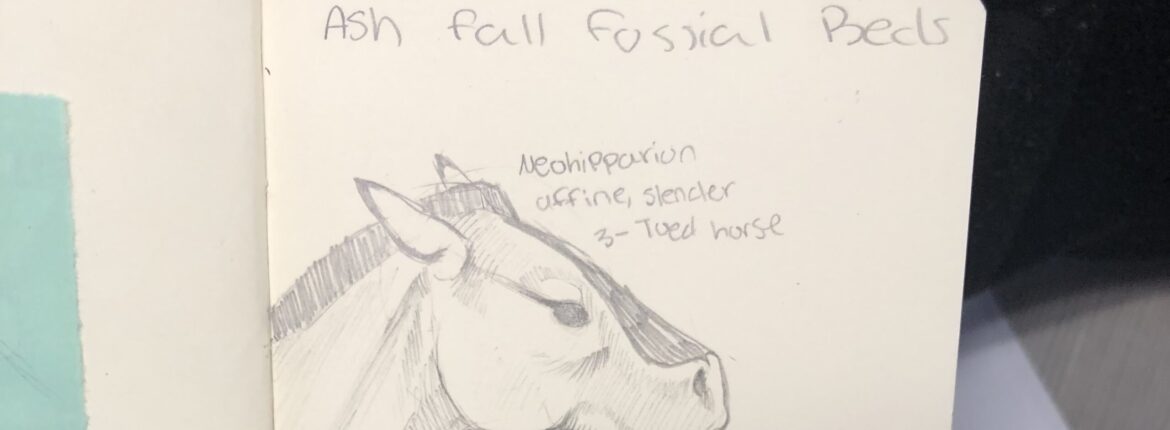
Walk into any high school math classroom, university lecture hall, or corporate boardroom, and you will find them: the margins of notebooks, the back pages of agendas, and scrap pieces of paper covered in intricate, repeating geometric patterns, complex caricatures, or deeply shaded landscapes.
Standard educational and clinical models have long labeled this behavior a distraction. The traditional verdict is clear: the individual is checked out, lacking the working memory capacity or attentional discipline to track the presentation.
However, when evaluated through the lens of performance mechanics, this persistent habit reveals an entirely different operational truth. Doodling is not a sign of a brain shutting down. It is an active distress flare—a flashing neon sign pointing directly to the ADHD brain's instinctual tool for cognitive survival. In an era dominated by algorithmic, passive digital consumption, that pen moving across the margin may be the last standing outpost of active, tangible creation keeping an executive system online.
The Attentional Anchor: Doodling to Remember
To understand why the "Master Doodler" phenomenon shatters the traditional deficit model, one must look at how the brain actually processes a low-dopamine environmental stream (like a dry lecture or a linear meeting).
As established in the case study of the "Parking Lot Overwrite," the ADHD attentional switching mechanism is highly aggressive; if it is under-stimulated, it will violently evict mundane data from the working memory buffer to scan the environment for a dopamine hook. If it finds none outside, the hyperfocus mechanism turns inward, launching into rumination, daydreaming, or a complete executive shutdown.
The Master Doodler avoids this crash by intentionally deploying a tactile kinetic loop.
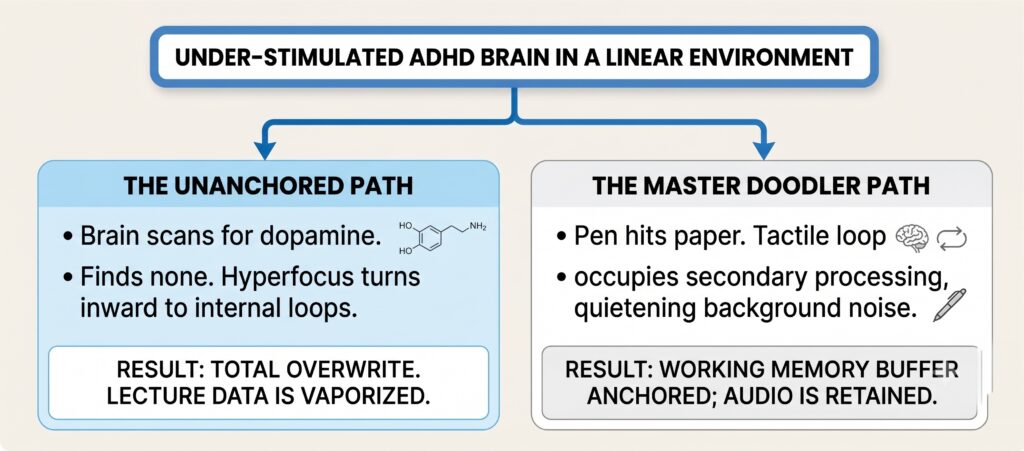
By keeping a small, automated slice of the visual and motor cortex occupied with drawing, the doodler creates a baseline level of neurological stimulation. This micro-dopamine feed acts as a stabilizer. It quietens the background noise of the room and prevents the brain from launching into a deep internal drift, leaving the auditory channel of the working memory buffer open to actually retain the speaker's words.
The Modern Crisis: Passive Consumption vs. Tangible Creation
In the modern digital landscape, this vital coping mechanism is under severe threat. The age of social media has engineered an environment of passive dopamine consumption—endless, low-friction scrolling feeds that mimic stimulation but completely bypass the central executive network.
For many ADHDers caught in this ecosystem, the urge to doodle represents the single remaining link to active creation.
| Feature | Passive Algorithmic Feeds | Tangible Doodling (Analog/Digital) |
| Dopamine Quality | Cheap, fleeting micro-spikes (Depleting) | High-yield, sustained satisfaction (Restorative) |
| Cognitive State | Fragmented, shallow, reactive | Deep, structured hyperfocus / flow |
| Executive Demand | Completely dormant | Actively tracks spatial and visual inputs |
| Vulnerability to Crash | High; drives brain fog and burnout | Low; builds a protective sensory shield |
When an ADHD brain is starving for dopamine, it naturally gravitates toward the easy fix of passive scrolling. However, this leaves the brain highly vulnerable to Rejection Sensitive Dysphoria (RSD) loops and executive paralysis, as the working memory has no structural anchor.
The Master Doodler’s notebook page is a literal protest against this cognitive depletion. It is a tangible space where the individual is forced to track coordinates, plan structural layout, and manage manual pressure. It is a high-yield, restorative dopamine engine built entirely by hand.
Weaponizing the Tell: The Ultimate Digital Reset
Because this "tell" is so explicit, it provides the exact roadmap needed to pull an ADHD individual out of a deep non-bipolar depressive feedback loop or a state of digital paralysis. Trying to introduce a completely foreign hobby or standard clinical exercise during an executive crisis fails because the cognitive friction is too high. The strategic play is to meet the brain exactly where its established highway lives: amplify the tangible interest.
This is precisely why handing a traditional analog doodler an advanced digital canvas—like an iPad paired with an Apple Pencil running Procreate—acts as a flawless cognitive capture.
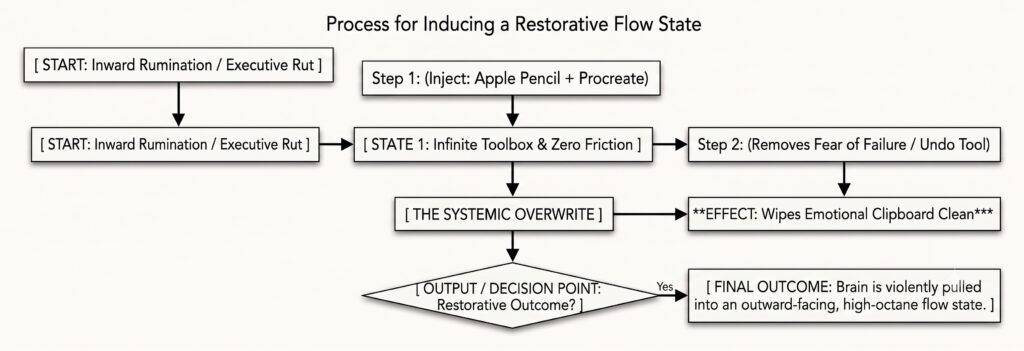
The transition is instantaneous because the tool perfectly optimizes the ADHD brain's strict operational demands:
- Eliminating Failure Friction: In the analog world, a stray line can ruin an entire piece, potentially triggering a mini-RSD loop. The digital layer and "Undo" system completely eliminate this barrier, maintaining a pure, low-stakes play state.
- Micro-Novelty Engines: The vast array of digital brushes, textures, and blending modes provides an endless stream of sensory novelty. The moment the brain begins to habituate to one style, a simple tap introduces an entirely new tactile-visual interface.
The sheer processing volume required to navigate this digital canvas issues an immediate, total eviction notice to the active working memory buffer. The brain cannot calculate brush opacity, track spatial lines, and experiment with color palettes while simultaneously holding onto a low-dopamine emotional loop. The old data is vaporized, the negative feedback loop drops dead, and the individual is dropped straight into an outward-facing state of peak artistic flow.
Conclusion
The Master Doodler is not an individual with an attention deficit; they are an expert in attention regulation, utilizing the tools at their disposal to keep a non-linear brain anchored to a linear world. By reading this tell, educators, clinicians, and individuals can stop fighting the brain’s natural mechanics. The pen moving across the margin isn't a sign of distraction—it is the blueprint for executive rescue.