
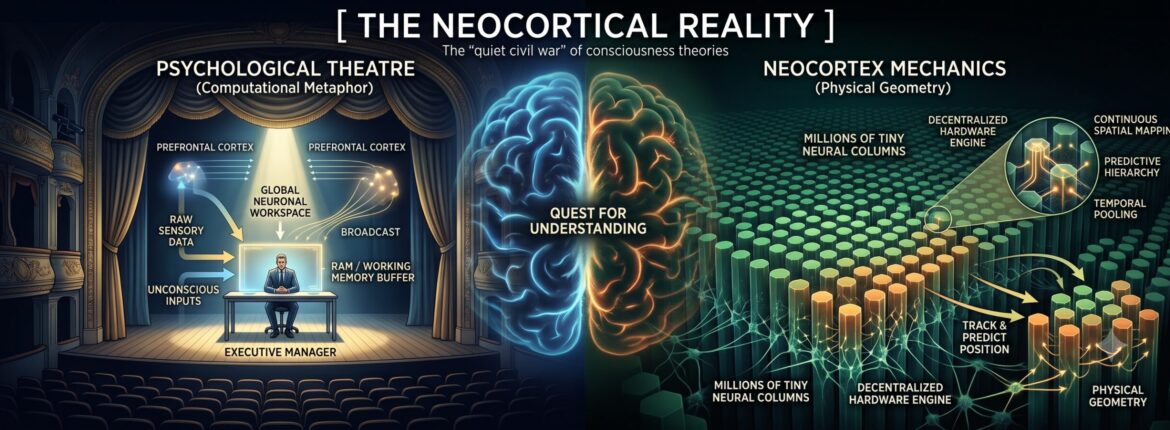
For over a century, the quest to understand human consciousness has been locked in a quiet civil war.
If you walk into a university psychology department, you will likely be told that consciousness is the ultimate software suite. Academic psychologists will describe it using computational metaphors: a centralized "Global Neuronal Workspace" or a cognitive "theatre" where the brain takes raw, unconscious data, shunts it into a temporary working memory buffer, and broadcasts it to the prefrontal cortex for deliberate action. In this view, consciousness is the executive manager sitting at the desk of the human mind.
But if you cross the campus to visit the labs of leading neocortical and neurobiological theorists, that desk completely vanishes.
Neocortical theorists—armed with mathematical models, cellular imaging, and frameworks like Hierarchical Temporal Memory—view the brain not as a computer running software, but as a uniform, decentralized hardware engine. To them, there is no specialized "RAM slot" for working memory, nor a central room where it all comes together. Consciousness isn't a magical workspace; it is simply what it feels like when millions of tiny, physical neural columns continuously track and predict their positions across spatial maps.
These two competing ideas represent the ultimate paradigm clash in cognitive science: Is consciousness an executive software function, or is it just the physical geometry of a predictive engine?
The Psychological View: The Global Theatre
Academic psychology approaches the mind from the top down, focusing on what consciousness does for human survival. Because humans can deliberate, weigh choices, and report their internal states, psychology treats consciousness as an elite, high-level processing buffer.
The dominant framework in this camp is Global Neuronal Workspace Theory (GNWT). Imagine the brain as a massive theatre dark room filled with isolated, unconscious actors—one handling visual processing, another handling raw emotion, another tracking motor memory. "Consciousness" occurs when a spotlight shines on a select few actors, bringing their information onto the stage (the fronto-parietal network) and broadcasting it to the rest of the system so the organism can make a unified decision.
Within this theatre, working memory is the script being held on stage. It is viewed as a literal cognitive container—a mental RAM slot that temporarily stores data so the conscious mind can manipulate it.
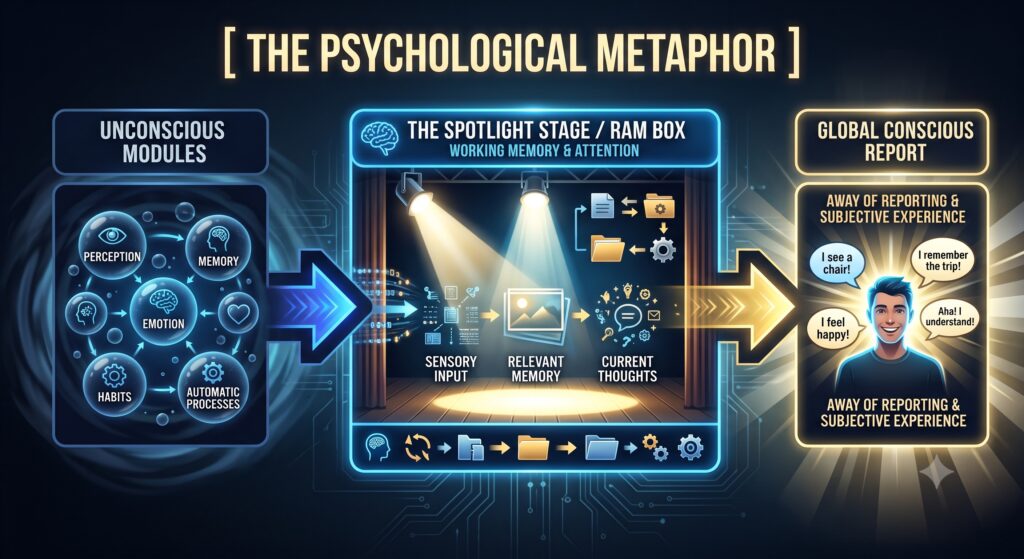
This model is intuitive because it mirrors our subjective experience: we feel like a unified "self" sitting behind our eyes, evaluating data and making choices.
The Neocortical View: The Decentralized Engine
Neocortical theorists look at the exact same brain and reach a radically different conclusion. They look from the bottom up, studying the physical architecture of the neocortex—the wrinkled outer layer of the brain.
When you look closely at the neocortex, you find a shocking truth: it is entirely uniform. The neural columns that process the sight of a baseball look identical to the columns that handle abstract physics equations or language in the prefrontal cortex. There is no unique, structural "theatre" or "executive office" built into the hardware.
Because the hardware is uniform, theorists like Jeff Hawkins argue that the brain doesn't shunt data into a separate memory workspace at all. Instead, every single cortical column uses built-in reference frames—the same neural mechanics used for physical navigation—to map the world.
In this framework, what we call working memory and consciousness are completely dissolved into two mechanical processes:
- Spatial Pooling: The instantaneous neural snapshot of what is happening right now.
- Temporal Pooling: The network’s ability to track sequences over time. When a network recognizes a pattern, a layer of cells stays continuously active, creating a persistent simulation.
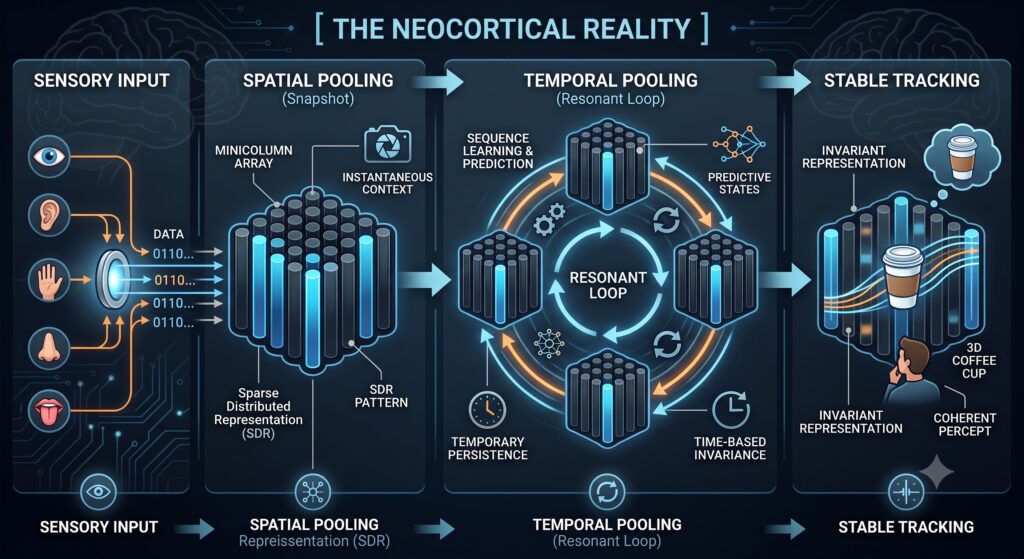
To a neocortical theorist, consciousness isn't an added executive property; it is just temporal pooling in action. Your working memory isn't a storage box in the prefrontal cortex; it is the network maintaining its activation patterns across physical maps. The office is empty; there are only millions of tiny tracking mechanisms perfectly synchronized across a physical landscape.
The Great Conceptual Clash
The divide between these two worlds changes how we interpret every facet of human behavior—especially peak states like hyperfocus or survival states like trauma.
| Feature | Academic Psychology (The Theatre) | Neocortical Theory (The Engine) |
| Core Metaphor | The Software / Computer RAM | The Hardware / Predictive Map |
| Working Memory | A distinct structural container for data | An emergent property of continuous sequence tracking |
| Location | Centralized in fronto-parietal networks | Decentralized across uniform cortical columns |
| Hyperfocus | Filling the working memory container to maximum capacity | A phase shift where competing maps collapse, causing perfect network resonance |
When an athlete is "in the zone" or a student enters a state of absolute hyperfocus, psychology suggests they are maximizing their conscious workspace. Neocortical theory suggests the exact opposite: the slow, clunky prefrontal workspace has been silenced entirely, allowing the raw, lightning-fast subconscious sensory-motor loops to execute predictions without interference.
The Verdict
Is consciousness a real, centralized executive workspace, or is it an illusion generated by a decentralized predictive engine?
Academic psychology provides the vital language to describe what it feels like to be human—our focus, our memory limits, and our functional choices. But as neurobiology digs deeper into the physical wiring of the neocortex, the software metaphor is beginning to fray. The future of cognitive science lies in bridging this chasm: recognizing that while the "theatre of the mind" is a brilliant illusion for navigating daily life, the reality underneath is a beautifully complex machine that doesn't need a manager to run the show.