
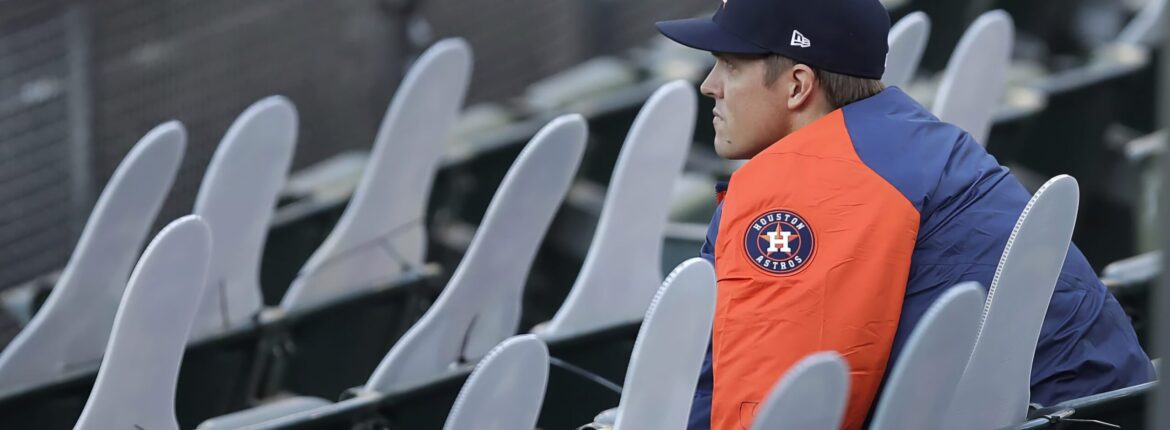
To the outside world, Zack Greinke is a collection of legendary, bizarre, and deeply endearing baseball folklore. He is the pitcher who sat with cardboard cutouts during a pandemic, the Cy Young winner who wanted to quit baseball to mow lawns, and the rookie who reacted to his Major League call-up by asking if he could play shortstop in Single-A instead.
But to treat these stories merely as quirky anecdotes is to miss the profound genius of his career.
Diagnosed with Social Anxiety Disorder (SAD) and clinical depression early in his career, Greinke did not survive twenty seasons in the Major Leagues by trying to fit into a neurotypical box. Instead, he completely discarded the social script of baseball. By treating the game as a purely mathematical, logical system, he engineered a psychological advantage that allowed him to live entirely rent-free in the minds of the greatest hitters of his generation.
1. The Neurodivergent Advantage: Radical Systematizing
Where others saw a game of emotional grit and unwritten rules, Greinke saw an algorithm. In psychological terms, he is a textbook systematizer—someone driven to analyze, construct, and predict the rules of a closed system. Because social interactions and standard clubhouse politics drained his energy, he deleted them from his programming. What remained was a hyper-focused, raw calculation of how to get twenty-seven outs.
This logical, unfiltered wiring manifested in ways that completely paralyzed opponents with cognitive dissonance:
- Radical Transparency: Pitchers and catchers guard their signs like state secrets. Greinke, finding the constant sign-shaking to be an inefficient waste of mental RAM, would simply call out his own pitches out loud to the batter, or shout his defensive alignment shifts across the infield before throwing.
- The "Hanging Slider" Experiment: When facing Joey Votto—one of the most cerebral hitters in modern history—Greinke threw a sequence of slow, non-breaking, hanging sliders. His math was flawless: he knew Votto was too smart for his own good. Votto’s brain was programmed to recognize spin and lay off the pitch. By throwing an intentionally "bad" pitch, Greinke forced Votto's hyper-analytical brain to completely short-circuit.
2. Decoupling from the "Social Script"
Hitters rely heavily on rhythmic, predictable patterns. They expect a pitcher to follow an established set of behaviors. Greinke realized that by entirely abandoning these social conventions, he could feed the hitter's internal "supercomputer" nothing but garbage data.
| The Standard Script | The Greinke Logic |
| Maintain Tempo:Keep a steady, rhythmic delivery to stay in a groove. | Rhythm Disruption: He would randomly throw a 50 mph eephus curve before pumping in a 90 mph fastball, destroying the hitter’s physical and temporal tracking. |
| Project Intimidation:Stare down the hitter, exhibit fierce emotion. | Flat Affect: He stood on the mound with a completely blank, expressionless face, treating the high-stakes environment like a quiet afternoon at a bus stop. |
| Silent Communication: Use complex, hidden finger signals with the catcher. | Off-Script Deception: He famously executed an exaggerated, highly theatrical "shake-off" of his catcher on a 3-1 count to Juan Soto. Soto’s brain screamed off-speed, only for Greinke to pump a fastball straight down the middle of the plate, leaving Soto frozen in pure disbelief. |
3. Cognitive Self-Preservation: The Lockdown and the Lawn
Greinke’s most famous eccentricities were actually highly logical boundaries designed to protect his mental health from the crushing weight of public scrutiny and sensory overload.
"I thought about mowing lawns for a living because I like to be outdoors... I kind of realized it wasn't baseball that I didn't like." — Zack Greinke on his 2006 hiatus.
When the pressure of being a top-tier prospect nearly broke him in 2006, he stepped away from the Kansas City Royals. He genuinely planned to buy a commercial lawnmower and start a landscaping business. He loved the kinetic, physical act of pitching and hitting, but despised the performative, public nature of being an athlete.
When he returned, he did so on his own terms. During the crowdless 2020 pandemic season, rather than sit in a cramped, noisy dugout, Greinke routinely climbed up into the fifth row of the empty stands to sit quietly among the cardboard fan cutouts. It was logical, physically distant, and gave him the quiet space he needed to process the game. When it was his turn to pitch, he simply walked down the steps, opened the field gate, and went to work.
4. The Shortstop on the Mound: Winning 6 Gold Gloves
Perhaps no quirk defined Greinke more than his lifelong obsession with playing shortstop. When Royals manager Mike Jirschele called a 20-year-old Greinke into his office in 2004 to tell him he was going to the Major Leagues, Greinke paused and asked:
"Do you think if we asked them they would let me go back to Single-A and be a shortstop? I think I can be a pretty good shortstop."
While he remained on the mound, that shortstop identity never left him. It is the exact reason he won six consecutive Gold Glove Awards (2014–2019). Most pitchers throw and fall off balance, effectively removing themselves as defenders. Greinke pitched with the sole purpose of immediately transitioning into an elite infielder.
1.The Infielder's Symmetrical Finish:Execution: Post-Release.
Instead of letting his momentum spin him offline, Greinke whipped his trailing leg around to square his shoulders directly to home plate.
2.The Low Center of Gravity:Execution: Land.
The millisecond his follow-through finished, his knees bent and his chest lowered. His glove remained out front—the exact "ready position" of an infielder waiting for a ground ball.
3.Hop, Drop, and Angle Tracking:Execution: Field.
Rather than waiting for slow rollers, Greinke charged the ball aggressively, "rounding" the hop to maintain perfect momentum toward his target. He routinely made barehanded, short-hop pick-ups on bunts.
4.Short-Arm Release:Execution: Throw.
Pitchers are built for long, looping arm paths. Greinke bypassed this entirely when fielding, using sidearm, submarine, or quick chest-flicks to throw runners out from impossible, off-balance angles.
The Legacy of a Singular Mind
By refusing to mask his neurodivergence, Zack Greinke turned what the sports world labeled "weirdness" into a Hall of Fame-caliber career. He realized early on that trying to act like a conventional athlete would destroy his love for the game. By protecting his mental peace, defying social expectations, and transforming the pitcher's mound into a fifth infield position, he didn't just play Major League Baseball—he solved it.