
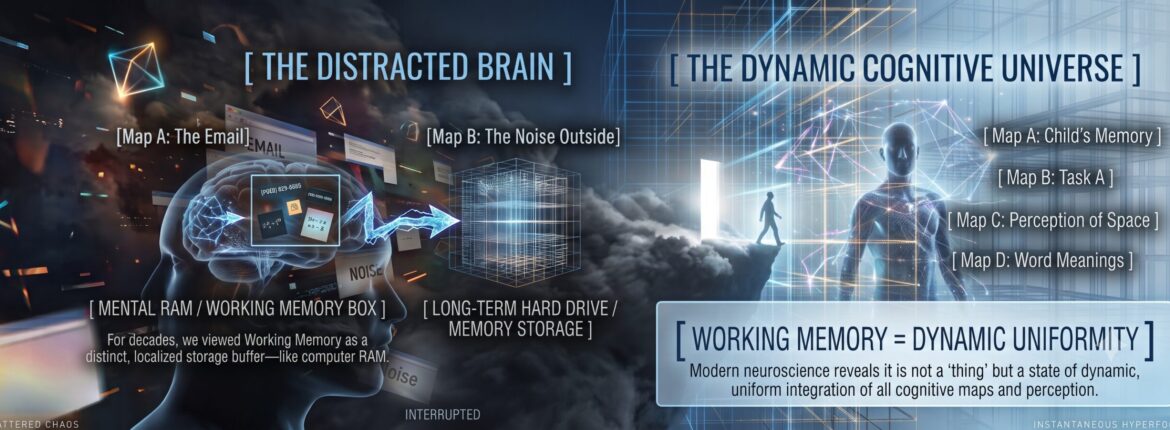
For decades, cognitive psychology has relied on a clean, comfortable metaphor to explain how we think: the computer.
In this classic model, your brain has a hard drive (long-term memory) where your childhood memories and language skills are stored. But when you need to solve a math problem, remember a phone number, or track a soccer ball across a pitch, your brain supposedly shunts that data into a temporary scratchpad—a mental workspace called working memory. It is treated like the brain’s RAM: a distinct, localized storage buffer, likely buried somewhere in the prefrontal cortex, that holds a handful of items in place before discarding them.
It’s an elegant theory. There’s just one problem: modern neuroscience is revealing that this standalone storage box doesn't actually exist.
What we call working memory isn't a "thing" at all. It is something far more dynamic, uniform, and deeply integrated into how we perceive reality.
The Monotonous Miracle of the Neocortex
The first major crack in the "mental RAM" theory comes from the physical architecture of the brain itself. If working memory were a dedicated system, we would expect to find a unique neural structure in the prefrontal cortex specifically designed for temporary storage—something entirely different from the parts of the brain that handle vision or touch.
But we don’t. As neuroscientists like Jeff Hawkins, creator of the Hierarchical Temporal Memory (HTM) framework, point out, the neocortex is shockingly uniform. Whether a cortical column is processing raw visual data from your eyes, tracking the sensory-motor mechanics of a tennis swing, or juggling abstract concepts in the prefrontal cortex, the underlying architecture looks identical.
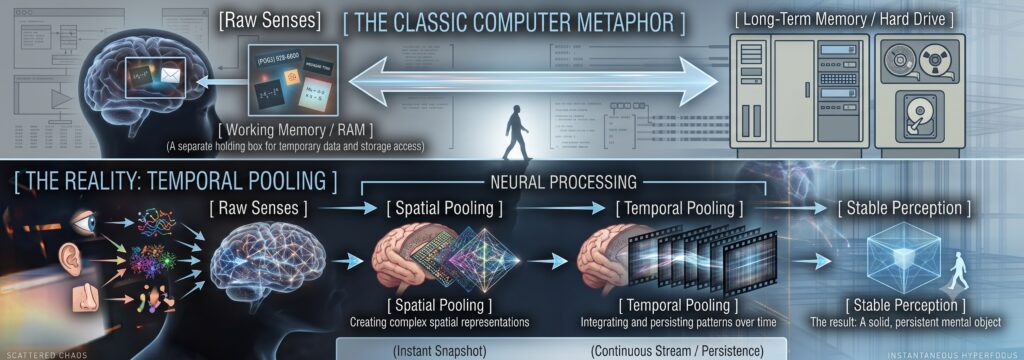
The brain doesn't have a specialized "processing zone" and a separate "storage zone." Instead, the exact same neural circuitry that perceives the world is the circuitry that remembers it.
Persistence Through Fluidity: Spatial and Temporal Pooling
If there is no mental RAM slot, how do we keep a thought, a number, or a moving target in mind? The answer lies in how the brain constantly predicts its environment through two continuous processes: spatial pooling and temporal pooling.
When you look at an object or listen to a sentence, your brain receives a chaotic, lightning-fast influx of sensory data. Through spatial pooling, your cortical networks instantly compress this noisy input into a stable, distinct pattern of active neurons—a snapshot of the "right now."
But the world moves. Your eyes flick, your body shifts, and the raw input changes entirely every millisecond. If your brain only possessed spatial pooling, your perception would shatter and reset hundreds of times a minute.
To solve this, the brain utilizes temporal pooling. This is the network’s ability to learn the sequence of changing patterns over time. When a cortical network recognizes a familiar sequence, a specific layer of cells remains continuously active, even as the inputs directly beneath it flux and change.
What we have historically called "working memory" is actually just temporal pooling in action. It is the capacity of a highly dynamic neural network to maintain a stable, active representation of a concept across time. It isn’t a box where data is stored; it is a continuous process that keeps the data alive.
Thinking in Places: Abstract Reference Frames
This changes our entire understanding of what happens when we "concentrate" or hold multiple things in mind.
In The Thousand Brains Theory, Hawkins notes that the neocortex repurposes the mechanism ancient mammals used for navigation—grid cells and place cells—to create internal reference frames for everything we experience.
When an athlete tracks a ball, their subconscious loops and cortical columns aren't holding the ball’s coordinates in a blank memory buffer; they are tracking its location relative to the physical reference frame of the playing field.
Similarly, when you are mentally organizing a complex idea, designing a project, or writing a syllabus, your prefrontal cortex isn't cramming variables into a temporary container. It is rapidly shifting its attention across locations in an abstract conceptual space. The persistence of those thoughts isn't data sitting in RAM; it is the network maintaining its activation patterns across those reference frames.
The Reality of Mind
The realization that working memory isn't a literal scratchpad changes how we view human intelligence. It means memory and processing are completely inseparable.
You do not retrieve a memory, place it in a workspace, alter it, and put it back. Instead, thinking is an active, sensory-motor journey through reference frames. The reason you can keep a thought in mind isn't because your brain has a great storage capacity, but because it has an incredible ability to run a stable, continuous simulation of the world.
Working memory isn't a thing. It is simply what it looks like when the brain's predictive engine stays focused on the path ahead.