
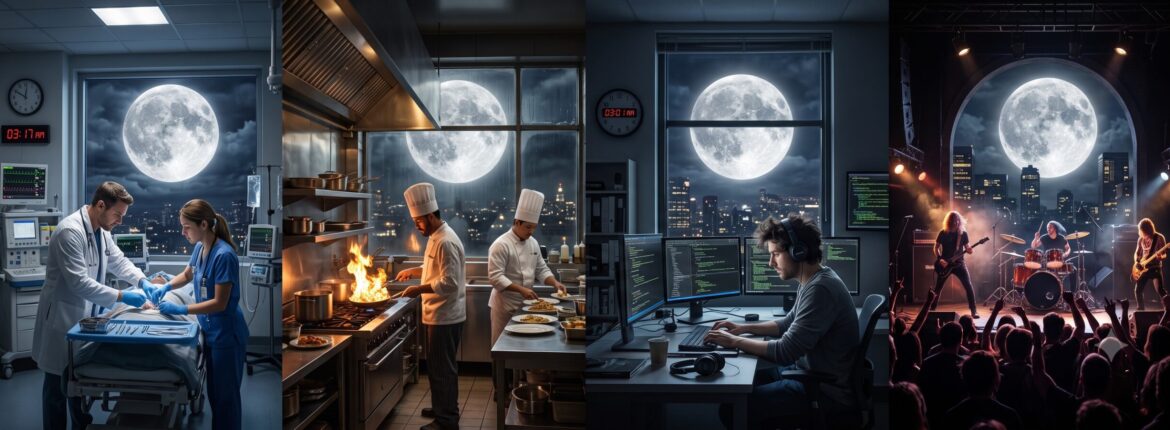
For decades, medicine treated the sleep issues plaguing individuals with Attention-Deficit/Hyperactivity Disorder (ADHD) as a secondary behavioral failure. It was dismissed as poor "sleep hygiene," a stubborn refusal to turn off the lights, or a byproduct of daytime restlessness.
Modern chronobiology and vocational data tell a radically different story. ADHD is fundamentally intertwined with a circadian rhythm disorder. The ADHD brain does not hate sleep; it is biologically hardwired to operate on a delay.
While this delayed clock creates a profound modern sleep crisis when forced into the rigid box of early-morning school and 9-to-5 corporate schedules, it transforms into an elite competitive advantage in professions that demand high-octane performance when the rest of the world is asleep. From the high-stakes chaos of the emergency room to the blinding lights of stadium rock tours and Broadway, the night is not a deficit—it is a vocational sanctuary.
1. The Biology of the Night Owl
To understand why people with ADHD thrive at night, one must first understand their internal clock. Research shows that roughly 73–78% of children and adults with ADHD experience a delayed sleep phase.
In a neurotypical brain, the hormone melatonin rises at a predictable evening hour to signal sleepiness. In the ADHD brain, the onset of dim-light melatonin is delayed by about 45 minutes in children and up to 90 minutes in adults.
This biological shift is compounded by a chronic deficit of dopamine and norepinephrine—the core neurotransmitters responsible for regulating wakefulness, attention, and reward. When an ADHD brain lacks adequate stimulation during a monotonous daytime routine, it experiences an alertness spike late at night. The internal mental noise quietens, the executive filters drop, and the brain enters a natural, high-velocity state of hyperfocus.
Historically, this was an evolutionary asset. The "Night Watch" theory suggests that early human tribes relied on a small percentage of individuals whose biological clocks were naturally shifted—people who were wide awake, hyper-vigilant, and functionally calm in the dead of night to protect the tribe from nocturnal predators.
2. The Pediatric Pivot Point: Loss of the Chemical Brake
This biological baseline faces a catastrophic disruption during adolescence. In early childhood, ADHD hyperactivity is highly external—fidgeting, running, and physical disruption. To manage these symptoms and protect sleep, pediatricians frequently prescribe alpha-2 adrenergic agonists like guanfacine or clonidine.
These medications act as a brake on the sympathetic nervous system, lowering central norepinephrine and reducing the body's "fight-or-flight" baseline. A massive secondary benefit of this mechanism is that it dampens physical tension and induces drowsiness, making it easier for a hyperactive child to fall asleep.
However, around age 15, a profound clinical shift occurs:
- Internalization: The overt, physical hyperactivity of childhood morphs into internal restlessness. The teenager stops bouncing off the walls, but their mind begins racing with intense internal thoughts, academic anxiety, and cognitive chaos.
- The Clinical Deception: Because the adolescent now appears physically calm during short doctor appointments, many pediatricians conclude they have outgrown their hyperactivity. They stop the guanfacine or clonidine prescriptions, shifting focus entirely to daytime stimulants.
Stripping away this chemical brake leaves the 15-year-old completely unprotected against bedtime hyperarousal. Their physical body is still, but their mind is operating at Mach 1. Staring at a dark ceiling with a racing mind feels torturous, driving them directly into the hands of the ultimate modern catalyst: consumer electronics.
3. The Digital Pandemic: Weaponizing a Vulnerability
If the biological gunpowder was already present, digital devices acted as the match, turning a chronic sleep delay into a full-scale modern pandemic among ADHDers. For an ADHD brain, a smartphone or tablet is an infinitely compounding dopamine delivery system.
The Dopamine "Infinite Scroll" Trap
ADHD brains live in a state of constant dopamine hunger. Algorithmic social media feeds, short-form video apps, and mobile video games are engineered to provide instant, unpredictable, and continuous gratification. While a neurotypical person might check the clock at midnight and choose sleep, an ADHDer entering a late-night dopamine loop triggers a state of deep hyperfocus. The executive function required to execute a transition—putting the phone down and closing their eyes—is completely paralyzed by the continuous reward loop.
Revenge Bedtime Procrastination
Because individuals with ADHD spend their days masking their traits, managing executive dysfunction, and fighting to keep up with rigid daytime structures, they experience massive cognitive fatigue by evening. The device becomes a tool for "revenge bedtime procrastination"—a desperate, late-night attempt to reclaim personal autonomy and low-stress stimulation, pushing sleep further into the early morning hours.
Hyper-Photosensitivity and Melatonin Suppression
Because the ADHD melatonin cycle is already naturally delayed, it is uniquely sensitive to light disruption. The short-wavelength blue light emitted by modern screens directly mimics daylight. When an ADHDer stares at a screen in a dark room, it actively suppresses what little melatonin is trying to accumulate, pushing a midnight bedtime into a catastrophic 2:00 AM or 3:00 AM window.
   [Screen Use & Late-Night Dopamine Seeking]
                       │
                       ▼
       [Suppressed Melatonin / Delayed Sleep]
                       │
                       ▼
          [Severe Sleep Deprivation]
                       │
                       ▼
 [Exacerbated ADHD Symptoms (Inattention, Impulsivity)]
                       │
                       ▼
    [Increased Need for High-Stimulus Devices]
         (To stay awake/focused during the day)
4. The Vocational Sanctuary: Where Hyperarousal Becomes a Superpower
The bitter irony of this biological profile is that the exact same traits that cause a sleep crisis in a standard classroom or office environment become elite professional assets when an individual enters a field that aligns with their nocturnal hyperarousal.
When the constraints of the 9-to-5 are removed, the late-night surge of mental and physical energy transforms from a disorder into a magnificent state of flow.
Tech Infrastructure, Software Engineering, and Cybersecurity
In the technology sector, the night is a clean slate. When daytime emails pause, Slack channels fall silent, and the sensory noise of the office drops to zero, the ADHD engineer finds an external "cone of silence." This absolute quiet allows their nighttime hyperarousal to channel directly into complex problem-solving. An engineer can spend six uninterrupted hours writing code, auditing network architecture, or hunting security vulnerabilities because their brain is finally firing on all cylinders without daytime friction.
Emergency Medicine and Graveyard Shift Operations
The Emergency Room at 3:00 AM is a masterclass in ADHD alignment. The baseline dopamine deficit of ADHD often manifests during the day as under-arousal (boredom, brain fog). In a late-night trauma bay, the intense adrenaline of a critical patient spikes the ADHDer's brain chemistry up to optimal operating levels, inducing an eerie, crystalline calm.
Furthermore, the ER demands rapid-fire micro-tasks rather than sustained, monotonous project management. Intubate a patient, read an X-ray, stitch a laceration, and pivot to an incoming ambulance—the high-velocity environment provides the transitions, keeping the brain perfectly engaged while others fight heavy waves of exhaustion.
The Adrenaline Arena: Professional Athletes
The connection between elite sports, night games, and ADHD is profoundly structural. For many athletes, their central nervous system does not fully prime itself until late afternoon or evening. The massive stakes, blinding stadium lights, crowd roar, and instantaneous physical feedback supply the exact surge of dopamine their brains crave.
In high-velocity positions—such as a soccer goalkeeper facing a penalty kick or a hockey goalie anchoring a shootout—there is zero time for internal dialogue. The internalized hyperactivity that causes insomnia at night is completely silenced by the speed of the game, transforming hyperarousal into lightning-fast reflexes and intuitive execution.
The Sensory Symphony: Professional Kitchens
Walk into a high-volume commercial kitchen during an 8:30 PM dinner rush, and you are looking at an environment tailor-made for ADHD. A line cook or chef must balance multiple sensory inputs simultaneously: the hiss of searing protein, the ticking clock of ticket times, the physical heat of the line, and verbal coordination with the kitchen expo. For a neurotypical brain, this is sensory overload; for an ADHD brain, this high-intensity chaos acts as an external regulatory force, locking them into a deep, highly efficient flow state. Because kitchen culture is inherently nocturnal, finishing a shift and cleaning down means these professionals naturally hit their beds long after 2:00 AM, working with their delayed sleep phase rather than against it.
Broadway and the Performing Arts
The theater world runs on a clock that perfectly mirrors the ADHD biological delay. The traditional Broadway schedule—with evening curtain calls at 7:00 PM or 8:00 PM and wraps near 11:00 PM—demands peak emotional, cognitive, and physical energy precisely when the ADHD brain enters its natural alertness window.
The live nature of theater provides immediate dopamine feedback from the audience, and the intense, multi-sensory environment of stage lights, costumes, and music suppresses internal mental static. Actors, stage managers, and technical crew members with ADHD frequently find their highest levels of executive function under the strict, high-stakes pressure of a live performance.
Touring Bands: The Ultimate Nomadic Flow
Perhaps no environment captures the union of nocturnal hyperarousal and high stimulation better than a musical ensemble on a tour routing. The lifestyle of a touring rock or progressive band completely discards standard societal schedules:
- The Midnight Peak: Load-in happens in the late afternoon, soundcheck in the evening, and the actual performance takes place between 9:00 PM and midnight. The performance itself is a massive, multi-sensory dopamine explosion—blaring monitors, flashing lights, heavy physical exertion, and deep artistic expression.
- The Nocturnal Travel Sanctuary: After the performance, the adrenaline and cortisol surge takes hours to clear the system. For a touring musician with ADHD, the early morning hours spent traveling on a tour bus or decompressing post-show are a natural comfort zone. They are surrounded by a subculture that completely normalizes sleeping until noon and peak output at midnight, entirely eliminating the toxic shame and exhaustion attached to daytime schedules.
Hollywood Production: The "Fraturday" Pressure Cooker
The film and television industry operates on brutal, non-linear schedules. Sets frequently shoot "splits" (midday to midnight) or pure night shoots (6:00 PM to 6:00 AM). Toward the end of a grueling week, production crews routinely face the infamous "Fraturday"—a Friday shoot that begins in the late afternoon and wraps long after the sun rises on Saturday morning.
While neurotypical crew members chemically crash by midnight, that mark is precisely when the ADHD brain enters its natural peak. The extreme financial urgency of a film set—where every minute over schedule costs thousands of dollars—creates an external pressure cooker that forces immediate hyperfocus, allowing an ADHD actor or director to deliver raw, deeply locked-in results.
5. Conclusion: Matching Structure to Biology
When we analyze these diverse fields side-by-side, a clear pattern emerges:
| The ADHD Trait | The Corporate / School Penalty | The Vocational Advantage |
| Delayed Sleep Phase | Chronic fatigue, brain fog, and executive failure at a 9:00 AM desk. | Peak mental clarity and physical energy during a late-night shift, performance, or crisis. |
| High Stimulus Seeking | Distraction by mundane administrative tasks, leading to digital escape. | Razor-sharp hyperfocus fueled by the adrenaline of the ER, the stadium, or a live set. |
| Internalized Hyperactivity | Intense internal mental static when forced to sit still in a quiet room. | An internal engine speed that perfectly matches high-velocity, unpredictable professions. |
The modern "sleep pandemic" among individuals with ADHD is not an inevitable tragedy of biology; it is a friction strike caused by forcing a nocturnal, high-stimulus brain into an early-morning, low-stimulus world. When left with nothing but a dark room and a racing mind, the ADHD brain will inevitably weaponize electronics to find the dopamine it lacks. Yet here lies a quiet, devastating cautionary tale: when those vital late-night hours are fully consumed by the passive, algorithmic traps of a smartphone screen until 3:00 AM, the time required to build an elite, nocturnal vocation is utterly stolen. The chronic exhaustion kills the exact cognitive bandwidth an adolescent needs to practice a guitar, write lines of code, master a kitchen knife, or develop the deep, specialized crafts and trades necessary to enter those thriving night-owl professions in the first place.
But when these individuals find their way into specialized, high-stakes, night-aligned vocations, the paradigm shifts entirely. They cease to be disordered. They become the exact people you want on the line, on the stage, or in the trauma bay when the rest of the world is fast asleep.