
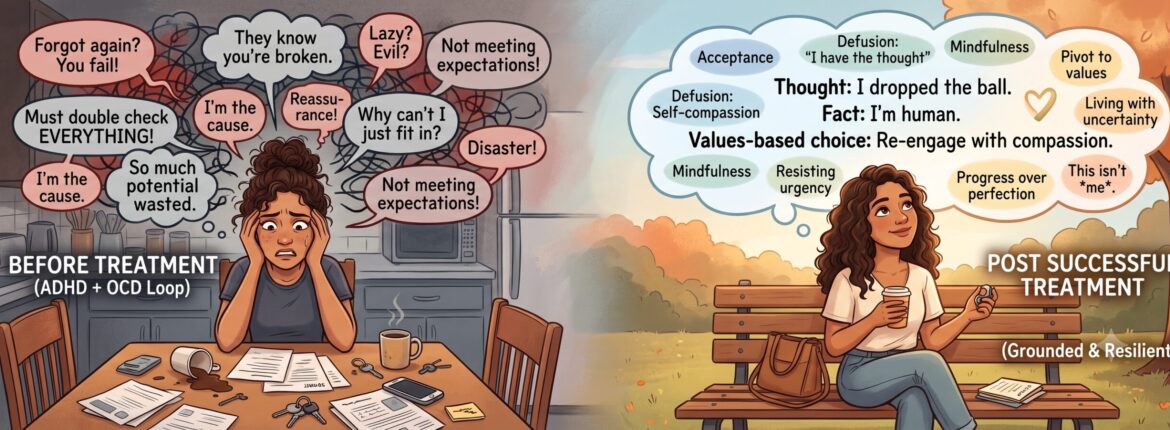
Treating the intersection of ADHD and OCD requires a highly deliberate, modified approach. Standard OCD treatment (like traditional ERP) can sometimes feel too rigid or under-stimulating for an ADHD brain, while standard ADHD coaching can accidentally feed into OCD compulsions—especially reassurance-seeking disguised as "problem-solving" or "checking."
To break the shame loop without feeding the compulsion cycle, clinicians typically look to a integrated, field-tested framework.
1. Modified Exposure and Response Prevention (ERP)
Traditional ERP asks a person to sit with anxiety without doing a compulsion. For an ADHDer, simply "sitting still with anxiety" can lead to extreme under-stimulation, causing the mind to wander deeper into intrusive thoughts.
- Actionable Strategy: Active ERP. Instead of static exposure, the individual engages in a physical or spatial task (like handwriting, sorting physical objects, or walking) while simultaneously resisting the urge to seek reassurance or check their work.
- The Pivot: When the ADHD brain "glitches" (e.g., misplacing a key), the exposure is leaving the key misplaced for 10 minutes without asking a partner, "Are you mad at me?" or checking the spot 20 times.
2. Acceptance and Commitment Therapy (ACT)
ACT is incredibly powerful for this specific dual diagnosis because it targets the false narrative directly through cognitive defusion. Instead of trying to prove the intrusive thought wrong (which triggers a reassurance cycle), the goal is to change the individual's relationship to the thought.
- Labeling the "Brain Noise": The individual learns to categorize thoughts. Instead of internalizing "I am a failure who forgot the meeting," they practice saying, "I am having the thought that I am a failure, and that is just my OCD weaponizing an ADHD attention slip."
- Value-Driven Action vs. Perfection: ACT focuses on moving toward core values rather than meeting an impossible standard of perfection. It answers the OCD's demand for absolute certainty with: "I might drop a ball today, but I am still going to show up for what matters."
3. "Symptom-Informed" Executive Function Support
If an educator, coach, or therapist tries to help an ADHDer build organizational systems without accounting for OCD, those systems quickly become rigid compulsions.
- The Rule of "Good Enough": Setting deliberate boundaries on executive function tools. For example, a planner or digital calendar can only be checked twice a day.
- Banning the Reassurance Loop: If the individual keeps asking, "Is this system perfect? Did I do this right?" the coach or therapist must gently refuse to validate the perfectionism, pivoting instead to: "It doesn't need to be perfect to be functional. Let's see how it works in reality."
4. Addressing the Neuro-Atypical Emotional Surge (RSD)
Because Rejection Sensitive Dysphoria (RSD) is so common with ADHD, the emotional pain of a perceived mistake hits hard and fast. OCD uses that raw emotional vulnerability to launch an intrusive thought attack.
- De-escalating without Judgment: The most successful intervention here is creating a completely non-judgmental environment where a mistake is treated purely as a sensorimotor or executive function variance—not a moral failing. When the individual realizes a dropped ball won't result in rejection, the OCD loses the fuel it needs to build a false narrative.
The Gold Standard Rule: In dual diagnosis treatment, OCD rules the clinical timeline. You cannot effectively treat ADHD executive dysfunction if the systems you build are immediately weaponized by OCD perfectionism. The internal narrative must be stabilized first.
Disclaimer: The information provided in this article is for educational and informational purposes only and is not intended as medical or psychological advice. While a completely non-judgmental environment is a powerful tool for de-escalation, this framework should not replace professional clinical evaluation. ADHD and OCD are complex neurodevelopmental and psychological conditions; individuals experiencing a compounding shame loop or intrusive thoughts should seek the support of a licensed therapist or specialist trained in dual-diagnosis frameworks to safely tailor these strategies to their specific needs.