
Traditional school systems are fundamentally built on a structural model that rewards sequential processing, conformity, and uniform paces. For a student with a highly active, nonlinear brain, the rigid environment of primary and secondary education often acts as a friction point rather than a catalyst for learning. When a high-IQ, hyperactive thinker checks out of the traditional academic pipeline, it is rarely a reflection of their intellectual capacity; rather, it is often the first step toward finding an arena that values practical execution over institutional compliance.
Part I: The Fallacy of the Deficit Paradigm
For youth with a neurodevelopmental profile blending ADHD with an exceptionally high rate of literal, black-and-white ASD language processing (AuDHD), traditional instruction can act as a freezing agent. A persistent and damaging narrative suggests that these individuals suffer from inherent motor command deficits, dyspraxia, or general clumsiness.
However, specialized, field-based results demonstrate that the breakdown is not a motor command issue at all; it is a rigid processing difference driven by language instruction and a brain that naturally tends to fixate on anomalies.
When a skill—whether it is an abstract mathematical concept or a complex physical movement—is taught entirely through standard verbal explanations, a hyper-literal mind builds discrete, isolated silos for each individual rule or definition. Because the processing is strictly absolute, these instruction-silos cannot seamlessly blend.
The brain is forced into a state of "cognitive saccades," awkwardly jumping from one static mental snapshot to the next. The dynamic, high-engagement ADHD half of the brain wants to sprint through a continuous flow state, but the hyper-systematic ASD processor demands that each literal milestone be calculated and cleared. This creates profound cognitive friction, locking the student into a rigid, fragmented, and mechanical model of the world.
Part II: Deconstructing the Visual Trap of Fixation
When trapped in a language-driven rule framework, a student's visual and physical tracking mirrors this internal fragmentation. On the putting green, this manifests as an anxious, high-alert scanning pattern where the eyes "ping-pong" rapidly back and forth between the anomalies on the green, the hole, and the ball.
[Language-Driven Rules] ---> Literal ASD Silos ---> Fixation on Anomalies ---> Performance Friction
[Task-Based Feel]       ---> ADHD Flow State   ---> Continuous Scanning ---> Fluid Sensorimotor Execution
In this state, the environment is not a single, continuous landscape. Every word, definition, and physical feature is treated as an isolated obstacle or an absolute target silo.
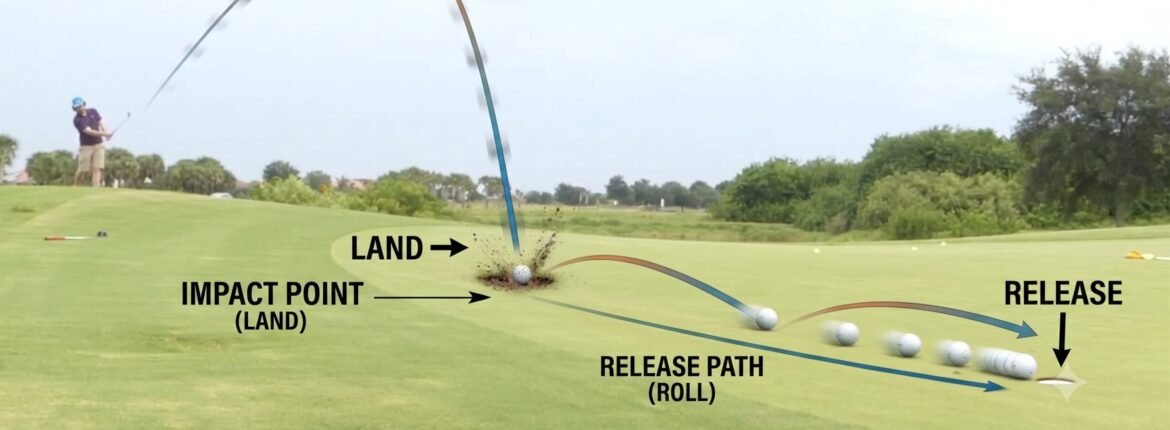
On pitch and chip shots, this literal framework forces a hyper-focus on the hole as the absolute destination. The mind calculates the distance to that single, static point and commands the ball to fly all the way there, completely failing to account for the dynamic, post-landing reality of kinetic release—causing shots to land by the hole and inevitably roll 10 feet past.
Part III: Bypassing the Code with Language-Free Manipulatives
To unlock true fluidity, instruction must bypass the literal, rule-bound linguistic engine entirely. This is achieved by introducing dynamic, language-free manipulatives that shift the brain from language-driven rules to pure sensorimotor feel. By starving the literal processor of verbal data, the neocortex is forced to build its reference frames using real-time, organic feedback—tactile pressure, kinetic rhythm, and spatial orientation.
1. The Elephant Walk: Replacing Snapshots with Flow
A textbook application of this shift is found in the Elephant Walk and continuous stomp drills popularized by golf instructor Shawn Clement. Traditional instruction bombards the student with linguistic phrases like "clear your hips" or "keep your leading arm straight."
The Elephant Walk substitutes verbal rules with a continuous, rhythmic, task-based objective:
- Continuous Fluidity: Because the drill requires a continuous step-and-swing movement, the brain cannot take a static snapshot or cognitive saccade mid-stride. It must process the weight shift as a singular, unbroken wave of momentum.
- Releasing the Ball-Bound Anchor: By stepping dynamically through the motion, the brain stops treating the ball as a rigid, literal stop-sign and begins treating it merely as a fluid intersection on a continuous spatial path.
- ADHD Regulation: The constant kinetic feedback of a walking and stomping rhythm provides the intense sensory stimulation that the ADHD brain craves to stay regulated, effectively muting the hyper-literal internal monologue.
2. Scanning the Green: Training the Eye
When a putting drill is utilized as a dynamic language-free manipulative, magic happens because the student learns to scan and not fixate. Instead of the eyes locking onto a single anomaly as a rigid obstacle, the language-free format allows the gaze to sweep across the green continuously. It retrains the visual tracking from jerky, saccadic jumps into a fluid pursuit, merging the ball, the slope, and the hole into a single, cohesive spatial map.
3. Visualizing the Release: Processing Natural Physics
The same transformation occurs in the short game by shifting the objective from a verbal instruction to a visual task: watching the ball fall out of the sky and release.
The moment the student stops fixating on the hole as a literal destination and starts tracking the arc of flight, the high-IQ neuroarchitecture instantly synthesizes the relationship between gravity, friction, and momentum without a single word of explanation. By tracking the full lifecycle of the shot, the eyes process the organic release of the ball, the body naturally adjusts its internal mechanics to hit the designated landing area, and the ball rolls gracefully to the hole.
Conclusion: Removing the "u" in AuDHD
By bridging the gap between calculation and intuition, this non-judgmental, experiential method provides an alternate, lower-friction language to process the world. While the underlying neural architecture of autism will always retain its affinity for structural integrity, routing learning through the sensorimotor pathway prevents the system from over-crystallizing.
[Linguistic Instruction] ---> Words ---> Literal Silos ---> Jerky, Saccadic Calculation
[Task-Based Feel]        ---> Motion ---> Continuous GRF ---> Organic, Unified Execution
This intentional shift essentially allows the student to temporarily remove the "u" in AuDHD. It softens the rigid, unyielding autistic structure, letting the methodical mapping pause so that the fluid, high-stimulus, reactive ADHD traits can take the wheel. By learning through task-based feel, the student is handed the ultimate cognitive gift: the ability to step out of fragmented, literal calculations and see a beautifully integrated, organic world through pure, continuous feel.