The Digital Book

ADHD Escape Room starts with a simple idea: when home, school, work, and relationships feel like an escape room to an ADHD or AuDHD person, that is where academic research has traditionally lived—the pathology, impairment, failure, and dysfunction. What has barely been explored is the other side: what prevents those environments from becoming an escape room in the first place? The book examines the people, environments, relationships, accommodations, and influence of trauma that can determine which side of that divide someone experiences, including people diagnosed much later in life who may have spent decades living on the largely unstudied side. That is where much of the gold may be hiding: by studying the conditions under which ADHD and AuDHD people thrive, we may finally understand how to build homes, schools, workplaces, relationships, and accommodations that never become escape rooms to begin with.

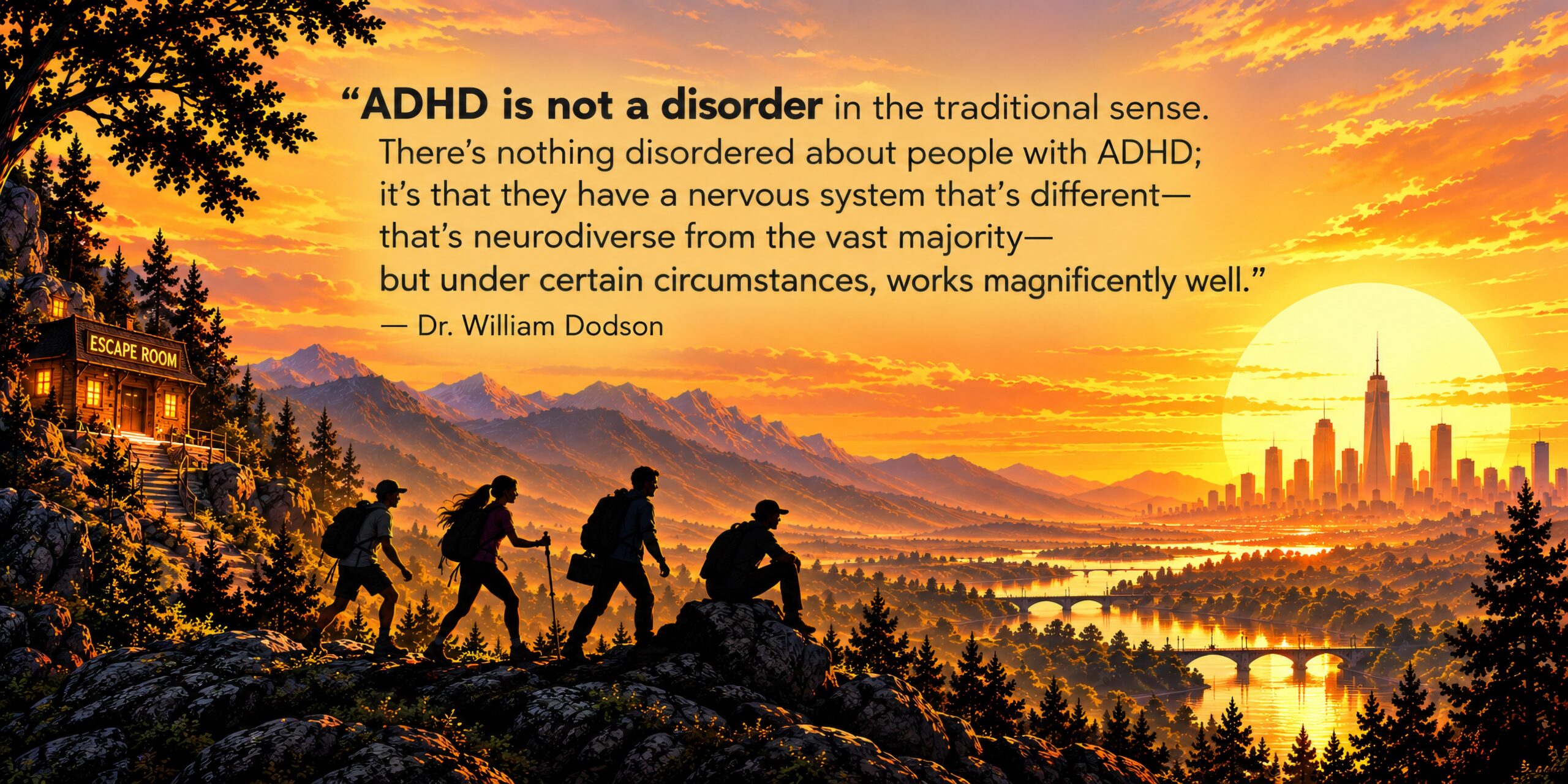
“Most of all I wanted to talk with the adults with ADHD who were NOT in my office. I wanted to know what they had figured out that so many others had not that allowed them to thrive and commonly do so without the aid of medications.”


Dr. William Dodson LF-APA

Draft Chapters/Sections ADHD Escape Room

Rejection Sensitive Dysphoria
When Perception Becomes Pain Before we go any further, we need to get one thing straight about Rejection Sensitive Dysphoria. RSD is about perception. That does not mean imaginary, fake, dramatic, or attention-seeking. It does not mean somebody with ADHD needs to toughen up, stop taking everything personally, or learn that the world does not […]
The ADHD Athletic Conundrum
The Executive Function Developmental Arc ADHD Research Has Barely Examined For decades, ADHD research has documented executive-function differences. We have studied inhibition, working memory, sustained attention, impulsivity, delayed consequences, emotional regulation, academic performance, medication response, and executive dysfunction. We have scanned ADHD brains and compared them with neurotypical brains. We have followed children longitudinally and […]
The Tyson Blueprint: Escaping the Home “Escape Room” Through Empathy and Scaffolding
There is a remarkably simple way to make childhood easier for an ADHD kid: don't make home an escape room. That doesn't mean eliminating rules. It doesn't mean permissive parenting, and it certainly doesn't mean letting children destroy the house, ignore other people, or do whatever the hell they want. It means creating a home […]
Rebooting Education: Why Doesn’t Public School Build a Road to Free College?
We keep talking about the cost of college in the United States as though the problem begins when a kid turns eighteen. It doesn't. By then, we've already spent thirteen years building the road that delivered the kid to that bill. So let's ask a different question: What if we built a different road? Finland […]
In the Math Classroom: The Scoreboard Is Not the Game, the Journey Is
My son Ben once taught me more about mathematics with five putts than most assessment systems ever could. We were working with a new putting stroke, and I set up a ladder at roughly 10, 15, 20, 25 and 30 feet. The scoring was simple. Leave it short and you get nothing, because short putts […]
The Neuro-ESOL Imperative: Translating the Nonlinear Lattice of the ADHD Brain
There is already a precedent for what I am proposing. We train teachers to work with English-language learners because we understand something fundamental: a child can be intelligent, capable, curious, and ready to learn while still experiencing a profound educational impairment when the language of the classroom does not match the language the child can […]
The Case of Nick Foles
Finding a Well-Scaffolded Home Nick Foles should not make sense. If you look at his NFL career as a conventional quarterback-evaluation problem, the pieces refuse to fit together. He produced one of the most efficient regular seasons in NFL history, continued winning the following year until an injury ended his season, deteriorated badly enough in […]
The Spatial Deficit: Why Scandinavia Is Abandoning the Keyboard to Save Mathematics
For over a decade, Scandinavia was celebrated as the vanguard of digital education. Classrooms across Sweden, Norway, and Finland aggressively swapped paper workbooks for tablets, standardized laptops, and cloud-based learning management platforms. Math instruction shifted from pencil-and-paper scratchpads toward keyboards, equation editors, and interactive user interfaces. Then the data arrived. Across successive rounds of the […]
The Hubris of the Lab Bench: Why ADHD Science Needs a “Reboot”
For decades, one of the recurring conclusions in ADHD research has been that children and adults with ADHD demonstrate poorer motor development or motor performance than their neurotypical peers. There are studies behind it, reviews behind it, and citations stacked upon citations behind it. And I am mostly convinced that a substantial portion of what […]

What You Will Find Here

ADHD Escape Room is being built in public as a modular digital book: evolving chapters and sections that bring together lived experience, education, sports psychology, neuroscience, and mathematical models of the neocortex to move beyond behavioral description toward underlying mechanisms and, most importantly, testable predictions. With ChatGPT and Gemini as rapid research, drafting, and adversarial editing partners, I can challenge assumptions, follow connections across disciplines, and memorialize smaller pieces here as they evolve into the finished book. Where the science is settled, I say so. Where it is not, the goal is to make the unanswered questions precise enough to test.

Because each section is designed to stand on its own, arguments, predictions, and references may appear more than once, with references kept local for immediate investigation. The finished book is intended to function like ice cores for paleoclimatologists and volcanologists: a Rosetta Stone of observations and testable predictions that specialists can interrogate. It also examines the institutional failures that have shaped how ADHD and AuDHD people are researched, educated, treated, and supported—especially the academic research system that influences many of those downstream institutions. That means asking what gets studied, what gets funded, how funding shapes the questions researchers ask, and why American psychiatric classification has moved so slowly while international frameworks have evolved. The larger purpose is to redirect some of that enormous research energy from pathology and impairment toward the other side of the map: the mechanisms, environments, accommodations, relationships, and conditions under which ADHD and AuDHD people compensate, achieve flow, and thrive.