The Digital Book

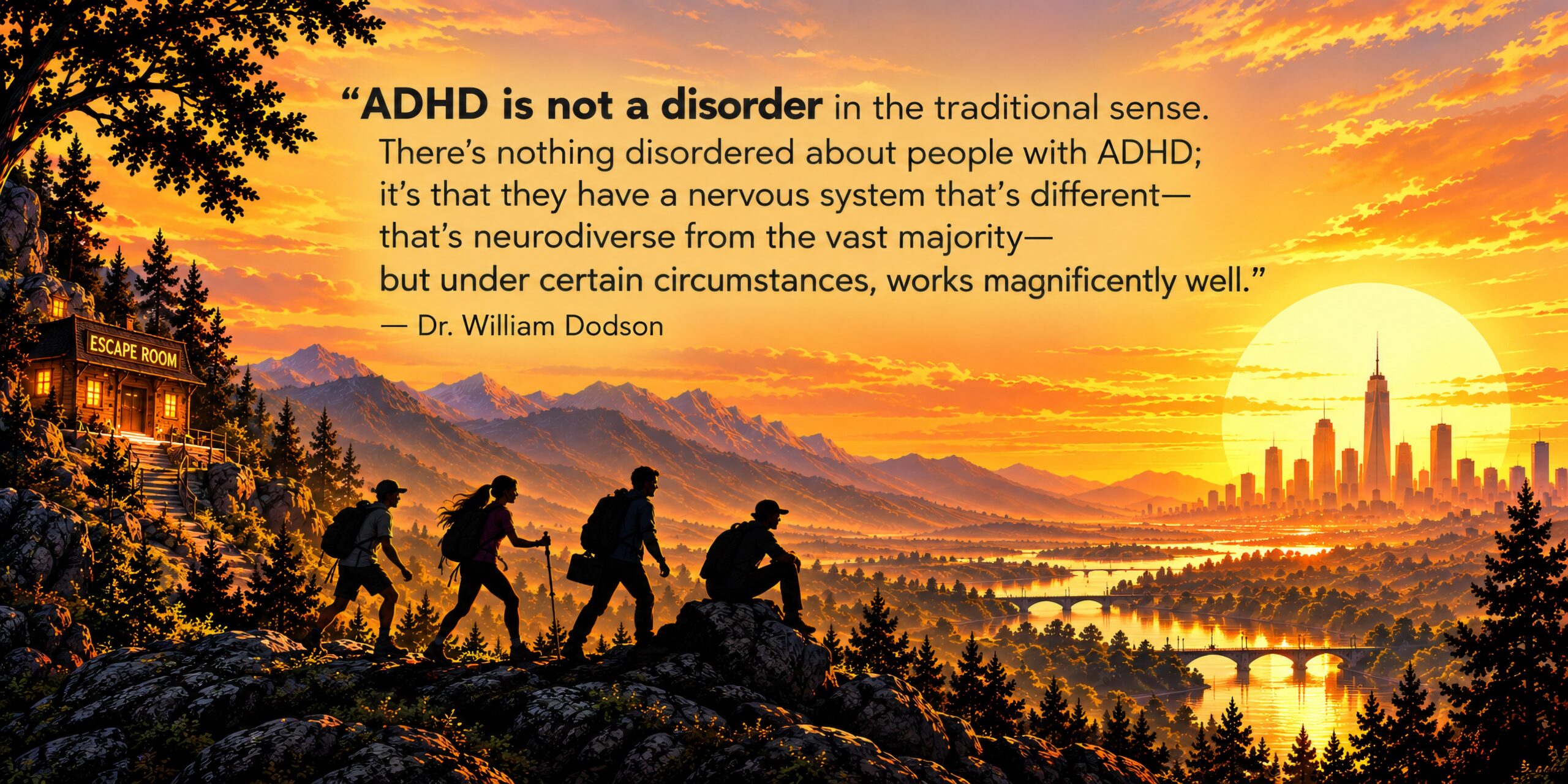
ADHD Escape Room starts with a simple idea: when home, school, work, and relationships feel like an escape room to an ADHD or AuDHD person, that is where academic research has traditionally lived—the pathology, impairment, failure, and dysfunction. What has barely been explored is the other side: what prevents those environments from becoming an escape room in the first place? The book examines the people, environments, relationships, accommodations, and influence of trauma that can determine which side of that divide someone experiences, including people diagnosed much later in life who may have spent decades living on the largely unstudied side. That is where much of the gold may be hiding: by studying the conditions under which ADHD and AuDHD people thrive, we may finally understand how to build homes, schools, workplaces, relationships, and accommodations that never become escape rooms to begin with.
“Most of all I wanted to talk with the adults with ADHD who were NOT in my office. I wanted to know what they had figured out that so many others had not that allowed them to thrive and commonly do so without the aid of medications.”


Dr. William Dodson LF-APA

Draft Chapters/Sections ADHD Escape Room

The Case of Rob Thomas: The Restless Mind, the Open Wound, and the Anchor Who Gave Him Somewhere to Stand
Pop-rock history is filled with artists who survived chaotic beginnings—musicians who struggled with anxiety, depression, substance use, restlessness, impulsivity, and the inability to fit comfortably inside ordinary institutions. It is also filled with artists who could barely organize the mundane parts of their lives while displaying almost frightening levels of organization inside the craft they […]
The Executive Disruptor: Why Teddy Roosevelt Was America’s First “Steve Jobs” President
The President Who Refused to Sit Still History books love to paint Theodore Roosevelt as a rugged cowboy, a monocled Rough Rider, or a booming voice shouting “Bully!” across the lawn. But look beyond the familiar caricature and something much more interesting emerges. Roosevelt was a voracious reader, an obsessive naturalist, a boxer, a rancher, […]
Creative Realms: When Different Minds Become Part of the Production System
There are realms where cognitive difference isn't merely tolerated. The work itself requires it. Animation is one of them. A Pixar movie cannot be made by a room full of people who think alike. The person building the software that makes thousands of individual hairs move convincingly across Sulley's body is solving a fundamentally different […]
When Toughness Becomes the Escape Room: What the FBI Can Teach Schools About Trust, RSD, and Reaching Kids
There is an assumption embedded in American education that becomes especially visible in schools serving children under enormous stress: some kids need us to be tougher. They need consequences and structure. They need somebody who will not tolerate excuses. They need to learn that the world is not going to accommodate them. I have heard […]
The Case of Chuck Jones: Chuck Amuck
Chuck Jones does not need a retrospective ADHD diagnosis to belong among the heroes of this book. He grew up and worked before ADHD was understood in anything resembling its modern form, but he described himself, his childhood, and his creative development in ways that today fit comfortably beneath the much broader umbrella of neurodivergence. […]
It’s Actually That Hard
Before anyone can understand why academic research has spent half a century pathologizing ADHD, they must first understand the structural trap that governs modern scientific inquiry. The modern research university and its federal funding conduits do not exist simply to solve complex systemic problems. They are institutions organized around disciplines, departments, laboratories, funding categories, peer-review […]
The Extended Now: Temporal Pooling, Spatial Pooling, and a New Hypothesis for ADHD Time Blindness
At eleven o’clock one night, I sat down to edit seventy-two testimonial videos for the graduating eighth graders at Kids Community College. We had recorded each student with a lavalier microphone and a shotgun microphone. There were multiple takes and a second camera for cutaways. Each finished testimonial would run roughly one to two minutes. […]
Toni Tyson Is the Mom Where Most ADHD Kids Wish They Had
There are children who grow up knowing that home is where they are understood, and there are children who grow up trying to escape it. Not necessarily because their parents do not love them or because anyone intends to hurt them. Sometimes the problem is much quieter than that. The child keeps receiving the same […]
AuDHD Beyond the Diagnostic Line
Why ADHD Plus Autistic Traits May Be the Definition We Actually Need I think we may be defining AuDHD around the wrong boundary. The common definition is straightforward: ADHD plus autism. If someone meets diagnostic criteria for ADHD and also meets diagnostic criteria for autism spectrum disorder, we call the combined presentation AuDHD. That definition […]

What You Will Find Here

ADHD Escape Room is being built in public as a modular digital book: evolving chapters and sections that bring together lived experience, education, sports psychology, neuroscience, and mathematical models of the neocortex to move beyond behavioral description toward underlying mechanisms and, most importantly, testable predictions. With ChatGPT and Gemini as rapid research, drafting, and adversarial editing partners, I can challenge assumptions, follow connections across disciplines, and memorialize smaller pieces here as they evolve into the finished book. Where the science is settled, I say so. Where it is not, the goal is to make the unanswered questions precise enough to test.

Because each section is designed to stand on its own, arguments, predictions, and references may appear more than once, with references kept local for immediate investigation. The finished book is intended to function like ice cores for paleoclimatologists and volcanologists: a Rosetta Stone of observations and testable predictions that specialists can interrogate. It also examines the institutional failures that have shaped how ADHD and AuDHD people are researched, educated, treated, and supported—especially the academic research system that influences many of those downstream institutions. That means asking what gets studied, what gets funded, how funding shapes the questions researchers ask, and why American psychiatric classification has moved so slowly while international frameworks have evolved. The larger purpose is to redirect some of that enormous research energy from pathology and impairment toward the other side of the map: the mechanisms, environments, accommodations, relationships, and conditions under which ADHD and AuDHD people compensate, achieve flow, and thrive.