
Article Archive

The Fluid Manifold vs. The Crystal Lattice: Math Giftedness, ADHD, and the ASD Savant
In the popular imagination, mathematical genius is almost always depicted the same way: a quiet, intensely focused individual staring at a chalkboard, instantly computing multi-digit primes or recalling flawless strings of numerical data. This is the classic trope of the Autistic Spectrum Disorder (ASD) savant—a mind resembling a high-powered, hyper-optimized linear algorithm. But there is […]

ADHD Health: The Cognitive Dangers of Benadryl as a Sleep Aid.
Using Benadryl (diphenhydramine) as a nightly sleep aid is a common desperation move for anyone struggling with insomnia, but for an ADHD brain, it is a uniquely counterproductive strategy. While it might knock you out temporarily, the underlying neurochemistry of diphenhydramine directly sabotages the exact brain networks an ADHDer needs to function the next day. […]

The Architecture of Rhythm: Neil Peart, Bill Bruford, and the Neurodivergent Drum Kit
In the world of progressive rock, two names sit uncontested on the Mount Rushmore of percussion: Neil Peart of Rush and Bill Bruford of Yes and King Crimson. Both were absolute masters of mathematical complexity, polyrhythms, and impossible time signatures. Yet, if you sit down and watch them play, their performances feel as though they […]

The Biology of a Scene: How Emotional Dysregulation Made Benedict Cumberbatch’s Khan an Unforgettable “Emotional Chameleon”
There is a moment in Star Trek Into Darkness that permanently altered how audiences viewed the iconic villain, Khan Noonien Singh. Locked inside a high-tech brig, framed by sterile glass, Khan delivers a monologue to Captain Kirk about the fate of his cryogenically frozen crew. His posture is perfectly still. His voice is cold, measured, and terrifyingly […]

The Tri-Star Synergy: How Neurodivergent Brilliance Shattered the “Deficit” Narrative in Star Trek Into Darkness
In the field of modern psychiatry, a fierce ideological battle is being waged over the neurodivergent brain. On one side stands the rigid, traditional medical model—personified by figures like Dr. Russell Barkley (whom many in the community sarcastically dub Dr. "Darkley"). This framework views ADHD strictly as a dark room of deficits, executive dysfunction, and […]

The Cryptomnesia Blueprint: Architecture of the Unconscious Leap
The story of Paul McCartney waking up with the melody of "Yesterday" completely intact—originally singing the placeholder lyrics "Scrambled eggs, oh my baby how I love your legs"—is perhaps the ultimate historical example of the "rubbery lattice" doing the work entirely off-stage. When a non-linear, hyper-associative brain is constantly stockpiling dots, the actual "writing" doesn't happen […]
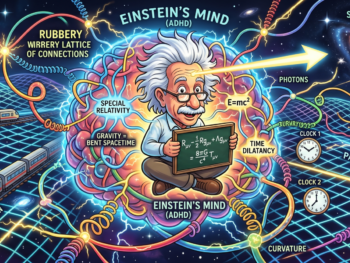
The Hyperfocused Fabric: Inside Einstein’s Rubbery Spacetime Lattice
The imagery of trains, stations, and moving clocks is famously at the heart of how Albert Einstein revolutionized our understanding of physics. While the idea of a "rubbery, wirery lattice" sounds like a vivid way to picture the interconnected web of space and time, the actual thought experiments that led to relativity were rooted in […]

The Non-Linear Court Vision: Anticipating the Unseen
Earvin "Magic" Johnson didn't just play basketball; he conducted an orchestra at 120 miles per hour. Standing at 6'9", he fundamentally broke the traditional blueprint of a point guard. While coaches of that era valued linear, systematic play—running predictable sets down the floor—Magic thrived on raw, intuitive, and highly responsive processing. When you look at […]

Non-Linear Genius: How Magic Johnson and Albert Einstein Mapped the Future
Comparing Magic Johnson’s court vision to Albert Einstein’s discovery of relativity reveals a fascinating parallel in how genius operates. Both men possessed a cognitive superpower: the ability to abandon rigid, linear viewpoints and instead map how space, time, and relative motion interact as a single fluid system. Einstein didn't discover relativity through abstract math alone; he did […]

Michael Vick: From the Miracle in the Meadowlands to a Miracle He’s Alive
On December 19, 2010, the New York Giants had the Philadelphia Eagles buried. With just under eight minutes left in the fourth quarter, the Giants held a commanding 31-10 lead. The home crowd in East Rutherford was already celebrating. Then, Michael Vick went completely nuclear. What followed was eight minutes of pure, unadulterated sports sorcery. […]

The Case of the ADHD Pope: Cardinal Bergoglio’s Field Hospital
The Man Who Wouldn't Stay Behind the Walls Before he became Pope Francis, he was Cardinal Jorge Mario Bergoglio of Buenos Aires. Long before he wore the white cassock, his ministry reflected a pattern that would become familiar to the world: an extraordinary willingness to abandon protocol when protocol interfered with human connection. There is […]

The Case of the ADHD Emissary”
The concept of a "hyper-reactive, non-linear brain driven by extreme empathy" reaches its historical zenith in the ministry of Dr. Martin Luther King Jr. If we look past the textbook caricature of King as a calm, statuesque monument and look instead at the chaotic, high-stress reality of how he actually operated, he fits the mold […]

The Case of the Sci-Fi Emissary: Benjamin Sisko and the Jazz of Non-Linear Leadership
When Starfleet Command assigned Commander Benjamin Sisko to the backwater station of Deep Space Nine, they thought they were deploying a standard, bureaucratic manager to oversee an orderly transition. They wanted a bureaucrat to follow the playbook, check the boxes, and file the paperwork. Instead, the universe gave them an Emissary. If Starfleet’s rigid, rule-bound […]

The Genetic Extinction of Innovation: Why a World Without ADHD Would Stand Completely Still
It is one of modern medicine’s favorite projects: identifying, tracking, and trying to "correct" the genetic variants associated with Attention Deficit Hyperactivity Disorder (ADHD). From a purely linear, bureaucratic perspective, the logic seems obvious. If we can smooth out the restlessness, eradicate the executive dysfunction, and teach every brain to sit quietly in a standardized […]

How Systemic Failures Lead to the Ultimate Escape Room: Prison
When these specific, acute layers of trauma—sexual assault, physical assault, and witnessing chronic violence at home, in the neighborhood, and/or at school—are forced onto an undiagnosed ADHD brain, the institutional pipeline accelerates with terrifying velocity. For a child navigating these horrors, the brain is not just under-stimulated; it is profoundly, constantly terrorized. Adding these layers of […]