
Article Archive

When Toughness Becomes the Escape Room: What the FBI Can Teach Schools About Trust, RSD, and Reaching Kids
There is an assumption embedded in American education that becomes especially visible in schools serving children under enormous stress: some kids need us to be tougher. They need consequences and structure. They need somebody who will not tolerate excuses. They need to learn that the world is not going to accommodate them. I have heard […]

Creative Realms: When Different Minds Become Part of the Production System
There are realms where cognitive difference isn't merely tolerated. The work itself requires it. Animation is one of them. A Pixar movie cannot be made by a room full of people who think alike. The person building the software that makes thousands of individual hairs move convincingly across Sulley's body is solving a fundamentally different […]
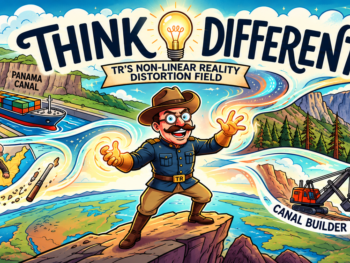
The Executive Disruptor: Why Teddy Roosevelt Was America’s First “Steve Jobs” President
The President Who Refused to Sit Still History books love to paint Theodore Roosevelt as a rugged cowboy, a monocled Rough Rider, or a booming voice shouting “Bully!” across the lawn. But look beyond the familiar caricature and something much more interesting emerges. Roosevelt was a voracious reader, an obsessive naturalist, a boxer, a rancher, […]

The Case of Rob Thomas: The Restless Mind, the Open Wound, and the Anchor Who Gave Him Somewhere to Stand
Pop-rock history is filled with artists who survived chaotic beginnings—musicians who struggled with anxiety, depression, substance use, restlessness, impulsivity, and the inability to fit comfortably inside ordinary institutions. It is also filled with artists who could barely organize the mundane parts of their lives while displaying almost frightening levels of organization inside the craft they […]

Engagement Gives You Access to Your Abilities: The Missing Variable in ADHD Research
The Child Who Couldn't Learn Motor Commands Imagine a young child with ADHD sitting in a laboratory, being asked to learn a sequence of motor commands. The researcher demonstrates a movement, the child attempts to reproduce it, and the researcher measures accuracy, timing, retention, and the ability to repeat the sequence. The child performs poorly, […]

Empathy as a Second Language: The ESL Model for Training Educators in ADHD
Part I: The Language We Never Taught Our Teachers We have a rather extraordinary contradiction in American education. We expect teachers to differentiate instruction for students with ADHD, yet we have never systematically equipped them with the training necessary to understand how those students become engaged, how they learn, or how their abilities develop. We […]

The APA and the DSM
The walls Jeff Hawkins encountered were not accidents. They were the product of an academic and institutional system that had spent decades narrowing the kinds of questions behavioral science was structured to ask. Hawkins approached the brain with the instincts of an engineer. Observable behavior was evidence, but it was not an explanation. If working […]

The Case of Alton Brown: How Scaffolding, Friction Removal, and Learned Executive Functions
There is something fascinating about Alton Brown’s kitchen. It is not simply organized. Plenty of kitchens are organized. Pots go in one cabinet, knives in another, spices in a rack, utensils in drawers. Everything can have a designated location while the cook still spends half the evening opening doors, digging through cabinets, moving one thing […]

ADHD, Trauma, Shame, Hyperfocus—and the Difference Between Having Intelligence and Being Able to Reach It
One of the strangest things about ADHD is watching intelligence appear and disappear without the intelligence itself changing. A person can demonstrate extraordinary pattern recognition, creativity, mechanical reasoning, verbal ability, or abstract thinking in one environment, then seem unable to summon those same resources somewhere else. From the outside, the easiest explanation is effort: if […]

I Knew the Rule
Two Predators, an ADHD Brain, and the Question I Asked Before the Research Did “Didn't your mom teach you not to talk to strangers?” Of course she did. I could have been told a thousand times not to talk to strangers. I knew the rule, understood the rule, and if you had asked me to repeat it, I could have given it back to you perfectly. That wasn't the problem. The problem was what happened when someone gave me positive attention. I could blow straight through the rule. For most of my life, I didn't understand that distinction. What happened to me as a child became entangled with a question about what I had done. I had talked to a stranger. I had violated the rule. An adult immediately reminded me that I had violated the rule. Somewhere inside that sequence, responsibility migrated from the predator to the child. It stayed there for decades. Two Predators, Two Different Doorways I was sexually assaulted by two different predators as a child, and looking backward, I can see that they did not reach me through the same doorway. The first was grooming. The abuse occurred over three separate, non-consecutive weekends. This wasn't a single impulsive encounter with a stranger. There was repeated access, familiarity, attention and time for boundaries to move. I didn't have the language for grooming then, but I can recognize the architecture now. The second predator reached me differently. That experience went straight through impulsivity. I knew not to talk to strangers. The information was sitting right there in my brain. But knowing a rule and reliably deploying that rule when an immediate reward appears in front of you are not the same neurological task. Give me positive attention in the moment and I could blow straight through it. Rule learned >> positive attention arrives >> immediate reward captures behavior >> rule fails to govern behavior >> predator gains access For years, I interpreted that sequence as something the child had done wrong. Decades later, a couple of ADHD kids doing animal impressions would change that. The Waiting Room Around 2013, I was sitting in the waiting room of Dr. Joseph Llinas watching a couple of ADHD kids doing what ADHD kids do. They were moving, improvising, bouncing from one thing to another. At some point they started doing animal impressions. Instead of telling them to settle down, I entered their world. I recognized what they were doing, gave them positive attention, and soon we had a competition going over who could do the best animal impressions. They clung to me. That got my attention. When I went into Dr. Llinas's office, I said: “I know that ADHD kids are more prone to physical abuse in the home. What about sexual abuse? Is there any research on sexual abuse in ADHD kids?” Dr. Llinas raised his eyes skyward and scanned his memory. “No, I don't think there's any research on that.” I responded: “I believe that ADHD kids, because of impulsivity, are easier targets for pedophiles.” Dr. Llinas looked at me. “It's amazing how you make all these connections.” And then another connection happened—not between ADHD and a research question, but between ADHD and me. I thought about the second predator who sexually assaulted me as a child. I thought about what happened when I came home afterward and my mother's best friend asked me: “Didn't your mom teach you not to talk to strangers?” Of course she had. I could have been told a thousand times not to talk to strangers. I knew the rule. But positive attention arrived, impulsivity took over, and I blew straight through something I absolutely knew I wasn't supposed to do. For decades, that distinction had escaped me. Sitting in Dr. Llinas's office, it suddenly didn't. “It wasn't my fault.” And I bawled. A research question I had arrived at by watching ADHD children in his waiting room had reached backward through decades of my own life and changed the meaning of something I had carried since childhood. My mother had taught me the rule. I knew the rule. The failure to deploy it in that moment did not transfer responsibility from the predator to the child. That was the moment the shame finally landed where it belonged: not on the little boy who talked to a stranger, but on the adult who sexually assaulted him. The Soccer Team In 2013, I had only part of the mechanism. I understood impulsivity, but I didn't yet understand the extraordinary power of being seen. That came years later. In 2019 and early 2020, before COVID shut everything down, I found myself mentoring a couple of ADHD middle-school kids who had essentially been thrown onto my soccer team as behavior problems. One of them was particularly instructive. In another environment, this kid could look anxious, oppositional and difficult. Conflict with a Karen mom was producing anxiety and something that looked a hell of a lot like ODD. That wasn't the kid I got. Once I connected with him, I got something almost comically different: a “coach-pleasing, stalking puppy who will run through a wall for you.” Same kid. Same ADHD. Different relationship. I hadn't medicated him, repaired an executive function, frightened him into compliance or finally discovered the perfect consequence. I had connected with him. He believed I liked him. He believed I understood him. He knew I was interested in what he could do instead of constantly waiting for what he would do wrong. And his behavior pivoted. Then my brain did what Dr. Llinas had commented on years earlier. It started making connections. What If the Adult Isn't Me? I knew what I was doing with that connection. I cared about the kid and wanted him to succeed. His attachment to me created an opportunity to coach him, encourage him and give him experiences of competence. Then I inverted the equation: What happens if the adult who discovers that doorway isn't me? What happens if he's a predator? That was when the question I had asked Dr. Llinas years earlier acquired another mechanism. Impulsivity could create vulnerability in the moment. But now I was seeing something else: the extraordinary motivational power an adult can acquire when an ADHD child who has spent years being criticized, rejected or misunderstood finally encounters somebody who appears to genuinely see him. A safe adult can use that connection to help. A predator can weaponize it. […]

It’s Not That Hard
There is a population of adults with ADHD that academic research has barely examined. They are not necessarily the people who arrive in a psychiatrist’s office because their lives have become unmanageable. They are the people who have found ways to thrive, sometimes without medication, and whose lives might teach us something about the conditions […]

The Irony of Innovation: How Norway Protected Brazil’s Street-Play Advantage and the Scientist Inside Every Child
The Country That Refused to Rush Childhood In the 2026 World Cup, Norway's meeting with Brazil provided a remarkable opportunity to examine two very different histories of childhood athletic development. The most interesting part of the comparison, however, began decades before either country's players stepped onto the field. Brazil has approximately 213 million people. Norway […]

The Self-Scaffolding Fallacy: Why ADHD Coaching Works for the Fortunate Few and Fails the Traumatized Majority
ADHD coaching has developed into a thriving cottage industry, offering practical assistance to individuals who struggle with organization, time management, prioritization, task initiation, and follow-through. Its appeal is understandable. Rather than concentrating exclusively on symptoms or diagnoses, coaches help people develop strategies for navigating the everyday demands of school, employment, and personal responsibilities. For many […]