
Athletics

When looking at how Belgium handles support for athletes with ADHD, the system is defined by a highly medicalized, localized, and divided infrastructure.
Because Belgium is politically split into distinct communities—mainly the Dutch-speaking Flemish Community (Flanders) and the French-speaking Walloon Community (Wallonia)—there is no single national blueprint. Instead, Belgium relies on a deep-rooted network of localized sports clubs, world-class adapted physical activity research, and a highly structured, rigid "Medical Prescription" model. Here is how the Belgian model supports neurodivergent athletes from […]

The Godfather of the “Mental Game”: Assessing Bob Rotella’s True Legacy in Sports Psychology
It is highly accurate to call Dr. Bob Rotella the "godfather" of applied sports psychology and how it is popularized across sports today—but in the broader history of psychology, he is more accurately the master of the "mental game" translation rather than the father of the scientific discipline itself. To map out where he truly stands, it […]

The Hyperfocus Edge: What US Classrooms Can Learn from Brazilian Sports Psychology
When looking at how Brazil approaches support for athletes with Attention Deficit Hyperactivity Disorder (ADHD), the landscape spans strict anti-doping regulations, high-performance coaching, and a deep cultural reliance on highly structured sports like Brazilian Jiu-Jitsu (BJJ) as therapeutic frameworks. But the most revolutionary element of the Brazilian model lies in its elite soccer academies. While […]

Channelling Hyperfocus: How Brazil Navigates Anti-Doping and Support for World Cup Athletes with ADHD
When looking at how Brazil approaches support for athletes with Attention Deficit Hyperactivity Disorder (ADHD), the landscape spans strict anti-doping regulations, high-performance coaching, and a deep cultural reliance on highly structured sports like Brazilian Jiu-Jitsu (BJJ) as therapeutic frameworks. Here is a breakdown of how the intersection of neurodiversity and athletics functions in Brazil today. […]

John Chaney: A Model Mensch for Teachers of ADHDers in the Classroom
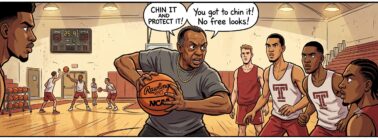
In college athletics, coaches are routinely judged by a ruthless calculus: wins, tournament appearances, and graduation rates. But the late, legendary Temple University basketball coach John Chaney operated on a different plane entirely. To Chaney, a basketball court wasn't just an arena for sport; it was a classroom, a sanctuary, and—most importantly—the home of a […]
ADHD: The Necessity of Showing Rather Than Telling
The necessity of showing rather than telling is a foundational concept when collaborating with, coaching, or leading individuals with ADHD. Because abstract verbal instructions require a high degree of mental sequencing and working memory, concrete visual examples act as a cognitive bridge. The dynamics of this approach are illustrated by the basketball examples, the bakery analogy, and […]
The Ancestral Engine: Why the ADHD Brain Thrives in Craft, Trade, and Action
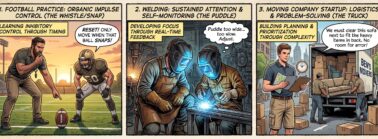
For decades, modern education and corporate culture have treated ADHD as a deficit of attention and executive function. Individuals with ADHD are frequently diagnosed as having "broken" internal wiring because they struggle to sit still for six hours, absorb abstract lectures, or organize their day using traditional planners and spreadsheets. However, when you strip away […]

The Vector of Real Empathy: Why We Are Failing Neurodivergent Kids and How to Fix It
My former psychiatrist, Dr Joseph Llinas, is a two time APA man of the year for his clinical research on ADHD and ASD kids from low income families. One day I once asked him based on two people I know who had challenges with their ADHD kids the following question “What percentage of the problems […]

The Goalkeeper Paradox: High-Stakes Focus, Spatial Clarity, and the Multisport Advantage
The goalkeeper position in soccer is a fascinating paradox: it is an isolated, highly specialized role that requires intense psychological resilience, making it uniquely suited for an athlete with ADHD. While it is often viewed as a "wallflower" position because the keeper stands apart from the continuous, fluid movement of the rest of the team, […]