
Articles
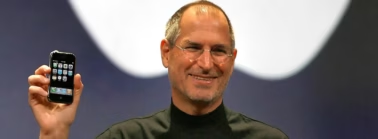
The Case of Steve Jobs’s Second Act at Apple, the “Michelin Star” Visionary
Steve Jobs’s second act at Apple is the ultimate case study in what happens when an intense, "Michelin Star" visionary learns better behavioral regulation, yet remains fundamentally driven by unfettered Rejection Sensitive Dysphoria (RSD). When Jobs returned to Apple in 1997, he was older, wiser, and more calculated. He had learned the institutional scaffolding required […]

The Case of an ADHD “Michelin Star Mind” and Unfettered Rejection Sensitive Dysphoria (RSD).
The Michelin Star Mind in the Quiet of Real Life: Understanding RSD When you take the "Michelin Star Mind" out of the high-heat environment and drop them into interpersonal relationships, that social friction is very often driven by unfettered Rejection Sensitive Dysphoria (RSD). RSD is an intense, agonizing emotional vulnerability to the perception—not necessarily the reality—of […]

The Chemical Straightjacket: Tracking the Shadow Arc of an ADHD Brain Misdiagnosed with Bipolar Type I
When pop star Demi Lovato revealed in her 2021 docuseries that she had been misdiagnosed with Bipolar Disorder—and actually had ADHD—it cast a stark light on an incredibly common psychiatric crossroads. For over a decade, her public narrative was built around the relief, and subsequent struggle, of treating a severe mood disorder. Without assuming or […]

How Systemic Failures Lead to the Ultimate Escape Room: Prison
When these specific, acute layers of trauma—sexual assault, physical assault, and witnessing chronic violence at home, in the neighborhood, and/or at school—are forced onto an undiagnosed ADHD brain, the institutional pipeline accelerates with terrifying velocity. For a child navigating these horrors, the brain is not just under-stimulated; it is profoundly, constantly terrorized. Adding these layers of […]

The Genetic Extinction of Innovation: Why a World Without ADHD Would Stand Completely Still
It is one of modern medicine’s favorite projects: identifying, tracking, and trying to "correct" the genetic variants associated with Attention Deficit Hyperactivity Disorder (ADHD). From a purely linear, bureaucratic perspective, the logic seems obvious. If we can smooth out the restlessness, eradicate the executive dysfunction, and teach every brain to sit quietly in a standardized […]
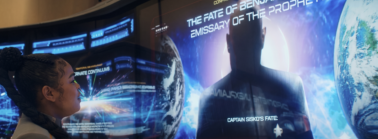
The Case of the Sci-Fi Emissary: Benjamin Sisko and the Jazz of Non-Linear Leadership
When Starfleet Command assigned Commander Benjamin Sisko to the backwater station of Deep Space Nine, they thought they were deploying a standard, bureaucratic manager to oversee an orderly transition. They wanted a bureaucrat to follow the playbook, check the boxes, and file the paperwork. Instead, the universe gave them an Emissary. If Starfleet’s rigid, rule-bound […]

The Case of the ADHD Emissary”
The concept of a "hyper-reactive, non-linear brain driven by extreme empathy" reaches its historical zenith in the ministry of Dr. Martin Luther King Jr. If we look past the textbook caricature of King as a calm, statuesque monument and look instead at the chaotic, high-stress reality of how he actually operated, he fits the mold […]

The Case of the ADHD Pope: Cardinal Bergoglio’s Field Hospital
The Man Who Wouldn't Stay Behind the Walls Before he became Pope Francis, he was Cardinal Jorge Mario Bergoglio of Buenos Aires. Long before he wore the white cassock, his ministry reflected a pattern that would become familiar to the world: an extraordinary willingness to abandon protocol when protocol interfered with human connection. There is […]

Michael Vick: From the Miracle in the Meadowlands to a Miracle He’s Alive
On December 19, 2010, the New York Giants had the Philadelphia Eagles buried. With just under eight minutes left in the fourth quarter, the Giants held a commanding 31-10 lead. The home crowd in East Rutherford was already celebrating. Then, Michael Vick went completely nuclear. What followed was eight minutes of pure, unadulterated sports sorcery. […]