
Institutional Failures
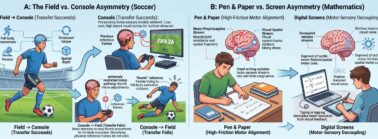
The Asymmetry of Learning: Sensorimotor Reference Frames in Mathematics and Physical Mastery
Executive Summary Modern educational technology operates on the implicit premise that digital interfaces—touchscreens, keyboards, and interactive software—are functional equivalents to physical, tactile interaction. However, advances in neocortical modeling (specifically Jeff Hawkins’ Thousand Brains Theory of Intelligence) and embodied cognitive neuroscience expose a fundamental flaw in this assumption: skill transfer between physical reality and digital simulation is strictly […]

The Nordic Digital Paradox: How Unfettered Screen Time Fractured Classrooms—and the “Neo-Basics” Pivot That Followed
For decades, the Nordic nations stood as the global benchmark for education and civic responsibility. Built on high social trust, robust funding, and a deep commitment to child development, their systems seemed nearly bulletproof. When these countries pioneered 1-to-1 technology initiatives—handing every student a laptop or tablet—the world assumed it was the dawn of a […]

The Digital Reckoning: How Screen Overuse, Sleep Deprivation, and the Loss of Play Unraveled the Nordic Educational Miracle
For decades, Scandinavia—and Finland in particular—stood as the undisputed beacon of global education. When the OECD released its early Programme for International Student Assessment (PISA) results in the 2000s, Finland was celebrated worldwide for achieving top-tier academic scores while maintaining equitable classrooms, short school hours, and minimal standardized testing. It was heralded as an educational […]

The Driveway Deficit: How the Collapse of Unstructured Play Altered Adolescent Socializing
The vanishing of unstructured "pickup" sports—the unorganized, self-policed games played in driveways, local parks, and dead-end streets—has dealt a quiet but devastating blow to adolescent social development. When youth sports shifted from spontaneous neighborhood play to hyper-structured, adult-run travel teams, kids lost more than just exercise. They lost the primary training ground for organic social negotiation, […]
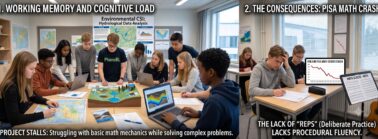
Finlands Phenomenon Based Learing and the Beginning of the Math PISA Scores Crash
No matter how engaging, authentic, or real-world a project is, you cannot bypass the reps when it comes to math. Mathematics is uniquely cumulative and hierarchical. While a student can jump into a complex historical or scientific phenomenon and analyze it conceptually, their ability to execute the underlying math depends on procedural fluency—and procedural fluency is built […]
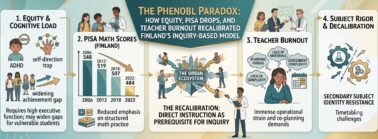
The PhenOBL Paradox: Why Finland Recalibrated Phenomenon-Based Learning
While Finland’s 2016 curriculum reform generated international buzz, the on-the-ground implementation of Phenomenon-Based Learning (PhenOBL) faced significant pushback from educators, researchers, and parents. The primary critique wasn't against project-based learning itself, but rather against the assumption that unstructured, student-led inquiry works equally well for every student and every subject. 1. The Disadvantage to Struggling and Neurodivergent Students […]

The Concert and the Scale: What Finland’s Inquiry Experiment Taught Us About the Craft of Math and Sentence
When news of Finland’s 2016 national curriculum reform swept through the educational world, international headlines framed it as a revolution: Finland was abolishing traditional subjects. The reality was far more measured. Through Phenomenon-Based Learning (PhenOBL), Finnish schools mandated interdisciplinary modules where real-world topics—like climate change or urban development—were investigated using tools from multiple disciplines simultaneously. The vision […]

It’s Not an Attention Deficit—It’s an “Engagement on Demand” Difference
In a recent post, I questioned why states mandate specialized ESOL/ELL training for general education teachers while requiring almost zero specialized training for teaching students with ADHD. The common explanation is that ADHD is a behavioral issue or an "executive function deficit." But as leading experts like Dr. William Dodson point out, ADHD is fundamentally […]

The Chaney Paradigm: Why Relationships Are the Only Way Classroom Consequences Work for ADHD Students
For a student with ADHD, standard behavioral consequences often fall completely flat. Traditional disciplinary models operate on a simple calculus: misbehavior equals punishment, which should theoretically deter future misbehavior. But in an ADHD brain—particularly one navigating the intense emotional currents of Rejection Sensitive Dysphoria (RSD)—this calculus doesn't just fail; it frequently backfires. The truth is, […]