
Rebooting Education

The Unpiloted Pivot: How Scandinavia Reversed Hyper-Digital Education Without Sample School
Executive Summary When Sweden and Denmark executed their dramatic pivot away from screen-heavy instruction and back toward physical textbooks, handwriting, and phone bans in 2023, they did so without running formal, state-sponsored "sample school" or pilot trials. Instead of conducting a multi-year pilot program, Scandinavian policymakers treated the preceding decade of hyper-digitalisation as an unproven, large-scale […]
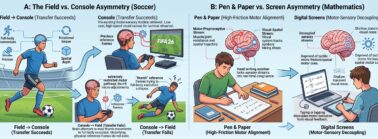
The Asymmetry of Learning: Sensorimotor Reference Frames in Mathematics and Physical Mastery
Executive Summary Modern educational technology operates on the implicit premise that digital interfaces—touchscreens, keyboards, and interactive software—are functional equivalents to physical, tactile interaction. However, advances in neocortical modeling (specifically Jeff Hawkins’ Thousand Brains Theory of Intelligence) and embodied cognitive neuroscience expose a fundamental flaw in this assumption: skill transfer between physical reality and digital simulation is strictly […]

The Nordic Digital Paradox: How Unfettered Screen Time Fractured Classrooms—and the “Neo-Basics” Pivot That Followed
For decades, the Nordic nations stood as the global benchmark for education and civic responsibility. Built on high social trust, robust funding, and a deep commitment to child development, their systems seemed nearly bulletproof. When these countries pioneered 1-to-1 technology initiatives—handing every student a laptop or tablet—the world assumed it was the dawn of a […]
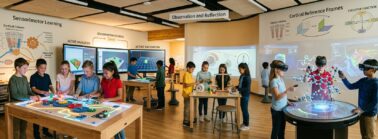
The Architecture of Active Learning: How Sensorimotor Inference Upgrades Executive Function in the Classroom
For decades, traditional pedagogy has operated on a foundational assumption: if a teacher presents information clearly enough, the student's brain will absorb it. We design classrooms around passive listening, abstract lectures, and symbolic worksheets, treating the mind like a empty vessel waiting to be filled with facts. Neuroscience tells a radically different story. In his groundbreaking work A […]

The Driveway Deficit: How the Collapse of Unstructured Play Altered Adolescent Socializing
The vanishing of unstructured "pickup" sports—the unorganized, self-policed games played in driveways, local parks, and dead-end streets—has dealt a quiet but devastating blow to adolescent social development. When youth sports shifted from spontaneous neighborhood play to hyper-structured, adult-run travel teams, kids lost more than just exercise. They lost the primary training ground for organic social negotiation, […]

Reclaiming the Sandlot: Why America Must Adopt Norway’s Youth Sports Model—Starting in Elementary School
In the United States, youth sports have ballooned into a privatized, hyper-competitive $30 billion industry. Elite travel teams, expensive private academies, and year-round single-sport specialization dominate the landscape starting as early as age seven. Yet, despite this massive financial investment, America is facing an unprecedented crisis in youth physical health and social well-being: roughly 70% of […]
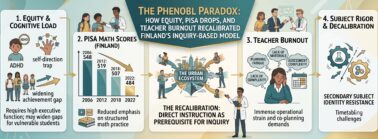
The PhenOBL Paradox: Why Finland Recalibrated Phenomenon-Based Learning
While Finland’s 2016 curriculum reform generated international buzz, the on-the-ground implementation of Phenomenon-Based Learning (PhenOBL) faced significant pushback from educators, researchers, and parents. The primary critique wasn't against project-based learning itself, but rather against the assumption that unstructured, student-led inquiry works equally well for every student and every subject. 1. The Disadvantage to Struggling and Neurodivergent Students […]
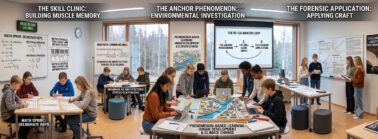
The Concert and the Scale: What Finland’s Inquiry Experiment Taught Us About the Craft of Math and Sentence
When news of Finland’s 2016 national curriculum reform swept through the educational world, international headlines framed it as a revolution: Finland was abolishing traditional subjects. The reality was far more measured. Through Phenomenon-Based Learning (PhenOBL), Finnish schools mandated interdisciplinary modules where real-world topics—like climate change or urban development—were investigated using tools from multiple disciplines simultaneously. The vision […]

The Great Sensorimotor Course Correction
For over a decade, primary and secondary education underwent a quiet revolution: the wholesale replacing of paper, pens, and bound physical textbooks with 1-to-1 digital screen initiatives. Tablets and laptops were promised as the ultimate equalizers—interactive, infinitely customizable, and natively digital for a digital world. Now, a major reversal is underway. Across Scandinavia, governments are […]