
ADHD Friendly Realms

The Case of the Sci-Fi Emissary: Benjamin Sisko and the Jazz of Non-Linear Leadership
When Starfleet Command assigned Commander Benjamin Sisko to the backwater station of Deep Space Nine, they thought they were deploying a standard, bureaucratic manager to oversee an orderly transition. They wanted a bureaucrat to follow the playbook, check the boxes, and file the paperwork. Instead, the universe gave them an Emissary. If Starfleet’s rigid, rule-bound […]

The Case of the ADHD Emissary”
The concept of a "hyper-reactive, non-linear brain driven by extreme empathy" reaches its historical zenith in the ministry of Dr. Martin Luther King Jr. If we look past the textbook caricature of King as a calm, statuesque monument and look instead at the chaotic, high-stress reality of how he actually operated, he fits the mold […]

The Case of the ADHD Pope: Cardinal Bergoglio’s Field Hospital
Before he was Pope Francis, he was Cardinal Jorge Mario Bergoglio of Buenos Aires. But long before he ever wore the white cassock, the architecture of his ministry was already defined by a distinct cognitive rhythm: a profound intolerance for rigid, static protocol, an insatiable need for raw sensory input, and a hyper-reactive emotional volume […]

The Executive Disruptor: Why Teddy Roosevelt Was America’s First “Steve Jobs” President
History books love to paint Theodore Roosevelt as a rugged cowboy, a monocled rough rider, or a booming voice shouting "Bully!" across the lawn. But if you strip away the 20th-century scenery and look strictly at the architecture of his mind, TR wasn’t a traditional politician at all. He was America's first true Silicon Valley-style […]

Non-Linear Genius: How Magic Johnson and Albert Einstein Mapped the Future
Comparing Magic Johnson’s court vision to Albert Einstein’s discovery of relativity reveals a fascinating parallel in how genius operates. Both men possessed a cognitive superpower: the ability to abandon rigid, linear viewpoints and instead map how space, time, and relative motion interact as a single fluid system. Einstein didn't discover relativity through abstract math alone; he did […]

The Non-Linear Court Vision: Anticipating the Unseen
Earvin "Magic" Johnson didn't just play basketball; he conducted an orchestra at 120 miles per hour. Standing at 6'9", he fundamentally broke the traditional blueprint of a point guard. While coaches of that era valued linear, systematic play—running predictable sets down the floor—Magic thrived on raw, intuitive, and highly responsive processing. When you look at […]
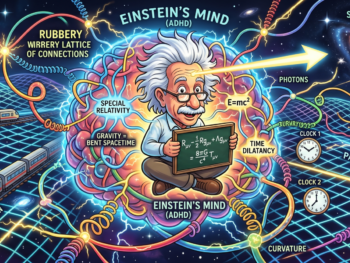
The Hyperfocused Fabric: Inside Einstein’s Rubbery Spacetime Lattice
The imagery of trains, stations, and moving clocks is famously at the heart of how Albert Einstein revolutionized our understanding of physics. While the idea of a "rubbery, wirery lattice" sounds like a vivid way to picture the interconnected web of space and time, the actual thought experiments that led to relativity were rooted in […]

The Cryptomnesia Blueprint: Architecture of the Unconscious Leap
The story of Paul McCartney waking up with the melody of "Yesterday" completely intact—originally singing the placeholder lyrics "Scrambled eggs, oh my baby how I love your legs"—is perhaps the ultimate historical example of the "rubbery lattice" doing the work entirely off-stage. When a non-linear, hyper-associative brain is constantly stockpiling dots, the actual "writing" doesn't happen […]

The Tri-Star Synergy: How Neurodivergent Brilliance Shattered the “Deficit” Narrative in Star Trek Into Darkness
In the field of modern psychiatry, a fierce ideological battle is being waged over the neurodivergent brain. On one side stands the rigid, traditional medical model—personified by figures like Dr. Russell Barkley (whom many in the community sarcastically dub Dr. "Darkley"). This framework views ADHD strictly as a dark room of deficits, executive dysfunction, and […]