
ASD
The Myth of Mental RAM: Why Working Memory Isn’t What You Think It Is
For decades, cognitive psychology has relied on a clean, comfortable metaphor to explain how we think: the computer. In this classic model, your brain has a hard drive (long-term memory) where your childhood memories and language skills are stored. But when you need to solve a math problem, remember a phone number, or track a […]
The Ghost in the Machine: The Illusion of the Focus Bridge and the Myth of Mental RAM
We have all experienced the sudden, almost violent transition. One moment, your mind is a scattered mess—a dozen browser tabs open in your brain, jumping from a half-written email to a stray noise outside, to an impending deadline. Then, a trigger hits. A sudden realization, a looming cutoff, or a captivating problem locks into view. […]
The Architecture of the Locked Mind: How Hyperfocus and Trauma Hijack the Classroom
Every day, teachers stand in front of classrooms trying to reach two types of students who appear to be polar opposites. The first is the student in a state of absolute hyperfocus—bent over a notebook or a screen, so deeply locked into a coding project, a historical narrative, or a physics problem that the school […]

The Play Deficit and ADHD: Why the Loss of Unstructured Play Has Made Adolescent RSD More Explosive Than Ever
For decades, researchers and parents have struggled to comprehend the escalating mental health crisis among teenagers. In adolescents with Attention Deficit Hyperactivity Disorder (ADHD), this crisis frequently manifests as an overwhelming, paralyzing state known as Rejection Sensitive Dysphoria (RSD). Characterized by extreme, unbearable emotional pain triggered by perceived or actual rejection, teasing, or failure, RSD was […]

The Cost of Institutional Blind Spots: Why Neglecting ADHD Hyperfocus Research Mutes Genuine Working Memory Impairments
For decades, academic literature has operated under a profound diagnostic paradox: it classifies Attention-Deficit/Hyperactivity Disorder (ADHD) strictly as a static attention deficit. Yet, clinical practice and frontline observation repeatedly witness the opposite—periods of intense, all-consuming concentration known as hyperfocus. Because modern neuroscience has historically treated hyperfocus as an unquantifiable quirk rather than a primary mechanism of attention […]

The Distress Flare in the Margin: What “Master Doodlers” Reveal About ADHD Working Memory and the Fight Against Digital Exhaustion
Walk into any high school math classroom, university lecture hall, or corporate boardroom, and you will find them: the margins of notebooks, the back pages of agendas, and scrap pieces of paper covered in intricate, repeating geometric patterns, complex caricatures, or deeply shaded landscapes. Standard educational and clinical models have long labeled this behavior a […]
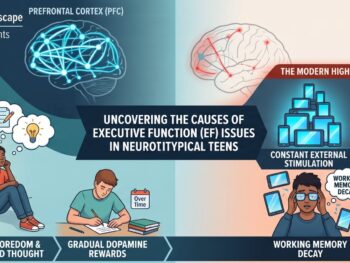
The Mirage of the “Broken Brain”: Why PFC Density Deficits are a Misleading Metric for ADHD
For decades, mainstream ADHD discourse—spearheaded by figures like Dr. Russell Barkley—has relied heavily on a deficit-based, biologically deterministic model. This framework frequently points to structural neuroimaging studies revealing a 3% to 10% reduction in prefrontal cortex (PFC) volume or gray matter density in individuals diagnosed with ADHD. The narrative built around this data is simple, clean, […]

The Mirror, the Tightrope, and the Anchor: Why Reaching ADHD Kids with Trauma Requires Us to Step Across the Line
Every teacher and parent of a neurodivergent child eventually finds themselves standing at the edge of a massive, unspoken divide. On one side is the rigid, clinical world of expectations, rules, and "standard" behavior. On the other side is the chaotic, brilliant, and deeply sensitive reality of the ADHD mind. To bridge this gap, adults […]

The Case of the Synesthetic Architect: How Brian Tyler’s AuDHD Savantism Redefines the Hollywood Soundscape
When listening to a sweeping cinematic score, most people experience a wave of emotion, a sense of scale, or a sudden spike in adrenaline. But for a select group of neurodivergent minds, a musical arrangement is not just an auditory experience—it is a physical, vibrating space pulsing with shape, texture, and a vivid explosion of […]