
Articles

The Architecture of Active Learning: How Sensorimotor Inference Upgrades Executive Function in the Classroom
For decades, traditional pedagogy has operated on a foundational assumption: if a teacher presents information clearly enough, the student's brain will absorb it. We design classrooms around passive listening, abstract lectures, and symbolic worksheets, treating the mind like a empty vessel waiting to be filled with facts. Neuroscience tells a radically different story. In his groundbreaking work A […]

The Razor’s Edge of Cinema: How Physical Film Editing Built Steven Spielberg’s Cinematic Brain
Long before he ever set foot on a Hollywood soundstage, a teenage Steven Spielberg sat at a small desk in his bedroom running 8mm and 16mm celluloid through his fingers. He held strips of film up to a light bulb, marked individual frames with grease pencils, scraped off emulsion, and physically spliced shots together using […]
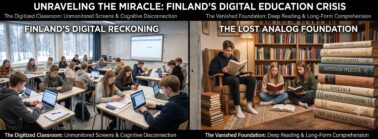
The Digital Reckoning: How Screen Overuse, Sleep Deprivation, and the Loss of Play Unraveled the Nordic Educational Miracle
For decades, Scandinavia—and Finland in particular—stood as the undisputed beacon of global education. When the OECD released its early Programme for International Student Assessment (PISA) results in the 2000s, Finland was celebrated worldwide for achieving top-tier academic scores while maintaining equitable classrooms, short school hours, and minimal standardized testing. It was heralded as an educational […]

The Driveway Deficit: How the Collapse of Unstructured Play Altered Adolescent Socializing
The vanishing of unstructured "pickup" sports—the unorganized, self-policed games played in driveways, local parks, and dead-end streets—has dealt a quiet but devastating blow to adolescent social development. When youth sports shifted from spontaneous neighborhood play to hyper-structured, adult-run travel teams, kids lost more than just exercise. They lost the primary training ground for organic social negotiation, […]

Reclaiming the Sandlot: Why America Must Adopt Norway’s Youth Sports Model—Starting in Elementary School
In the United States, youth sports have ballooned into a privatized, hyper-competitive $30 billion industry. Elite travel teams, expensive private academies, and year-round single-sport specialization dominate the landscape starting as early as age seven. Yet, despite this massive financial investment, America is facing an unprecedented crisis in youth physical health and social well-being: roughly 70% of […]
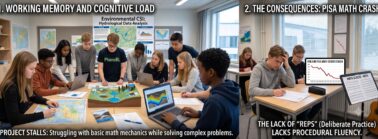
Finlands Phenomenon Based Learing and the Beginning of the Math PISA Scores Crash
No matter how engaging, authentic, or real-world a project is, you cannot bypass the reps when it comes to math. Mathematics is uniquely cumulative and hierarchical. While a student can jump into a complex historical or scientific phenomenon and analyze it conceptually, their ability to execute the underlying math depends on procedural fluency—and procedural fluency is built […]
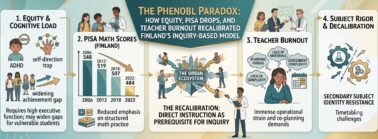
The PhenOBL Paradox: Why Finland Recalibrated Phenomenon-Based Learning
While Finland’s 2016 curriculum reform generated international buzz, the on-the-ground implementation of Phenomenon-Based Learning (PhenOBL) faced significant pushback from educators, researchers, and parents. The primary critique wasn't against project-based learning itself, but rather against the assumption that unstructured, student-led inquiry works equally well for every student and every subject. 1. The Disadvantage to Struggling and Neurodivergent Students […]
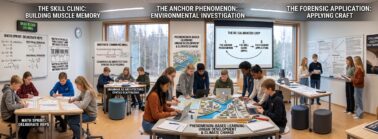
The Concert and the Scale: What Finland’s Inquiry Experiment Taught Us About the Craft of Math and Sentence
When news of Finland’s 2016 national curriculum reform swept through the educational world, international headlines framed it as a revolution: Finland was abolishing traditional subjects. The reality was far more measured. Through Phenomenon-Based Learning (PhenOBL), Finnish schools mandated interdisciplinary modules where real-world topics—like climate change or urban development—were investigated using tools from multiple disciplines simultaneously. The vision […]

The 3D Mind on a 2D Page: Why 2E Non-Linear Creators Freeze—and How Dr. Dodson’s “Romania Strategy” Unlocks Them
For the twice-exceptional (2E) mind—where elite quantitative, spatial, or conceptual aptitude exists alongside an ADHD neurotype—the act of creation begins with a fundamental paradox. Hand a 2E thinker a high-level math problem, a code architecture challenge, or a complex structural mystery, and their brain moves with blinding speed. The problem statement bounds the universe, defines […]