
Institutional Failures

The Hubris of the Lab Bench: Why ADHD Science Needs a “Reboot”
For decades, one of the recurring conclusions in ADHD research has been that children and adults with ADHD demonstrate poorer motor development or motor performance than their neurotypical peers. There are studies behind it, reviews behind it, and citations stacked upon citations behind it. And I am mostly convinced that a substantial portion of what […]

The Digital Trojan Horse: How Unlocked School Laptops Stole Our Children’s Sleep
For years, the widespread rollout of 1-to-1 school laptop programs was marketed as the ultimate equalizer—a progressive leap toward digital equity and modern literacy. Parents were told that supplying children with school-issued devices was a necessary investment in their academic future. Trusting these sanctioned tools as safe and educational, families welcomed them into the home […]

The Mechanical Blind Spot: ADHD and Trauma
For decades, one of the dominant academic narratives of ADHD has been anchored to a mechanical premise: ADHD is fundamentally a disorder of behavioral inhibition and executive control. Few researchers did more to establish and defend that framework than Dr. Russell Barkley. His landmark 1997 theory was remarkably explicit. ADHD, Barkley wrote, “comprises a deficit […]
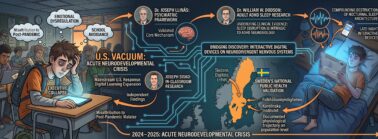
The Global ADHD/ASD Social-Media-Based Severe Sleep Deprivation Crisis
Bridging the 2024–2025 Clinical Discovery, Dr. Joseph Llinás’ Psychiatric Framework, Dr. William Dodson’s Adult ADHD Sleep Research, and Sweden’s National Public Health Validation The U.S. Vacuum and the 2024–2025 Discovery Between 2024 and 2025, an acute neurodevelopmental crisis escalated across American classrooms: adolescent students with Attention-Deficit/Hyperactivity Disorder (ADHD) and Autism Spectrum Disorder (ASD) experienced unprecedented […]
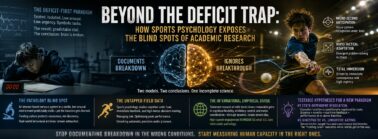
How Sports Psychology Exposes the Blind Spots of Academic Research
American neurodevelopmental research remains fundamentally locked in a deficit-first paradigm. By evaluating cognitive function primarily through seated compliance, isolated laboratory variables, and endurance for low-urgency symbolic tasks, institutional psychiatry documents the mechanics of behavioral breHow Sports Psychology Exposes the Blind Spots of Academic ADHD Research A Science of Pathology Without a Science of Potential American […]

Violent Discipline, Culture, and Neurodiversity in Latin America and the Caribbean
Disclaimer: While the research highlighted in this article illustrates systemic trends and the disproportionately high rates of harsh discipline in these regions, these data points reflect regional averages—not the reality of every home. Countless parents and caregivers across Latin America, the Caribbean, and around the world reject physical and verbal abuse, navigate parenting with deep empathy, […]

Compounding Crisis: ADHD, Violent Discipline, and the Global Reality of Child Protection
The global reality of childhood discipline revealed by UNICEF's long-term research reveals a staggering baseline: roughly 1.6 billion children aged 2–14 (2 in 3 worldwide) regularly endure violent discipline, including psychological aggression and physical punishment, at the hands of their primary caregivers. Nearly 400 million children under age 5face violent discipline globally, underpinned by deep-seated social norms where more […]

The Illusion of Inexpensive Electrons: The Financial Calculus Behind the K-12 Digital Conversion
Over the past decade, primary and secondary public education systems across North America underwent a structural transformation, shifting from physical textbooks to 1-to-1 digital device deployment. While this transition was often framed in pedagogical terms—promising "interactive engagement" and "personalized learning"—the foundational impulse driving school administrators was grounded in financial calculus. Educators and district CFOs were […]

The Unpiloted Pivot: How Scandinavia Reversed Hyper-Digital Education Without Sample School
Executive Summary When Sweden and Denmark executed their dramatic pivot away from screen-heavy instruction and back toward physical textbooks, handwriting, and phone bans in 2023, they did so without running formal, state-sponsored "sample school" or pilot trials. Instead of conducting a multi-year pilot program, Scandinavian policymakers treated the preceding decade of hyper-digitalisation as an unproven, large-scale […]