
Rebooting Education

The Spatial Deficit: Why Scandinavia Is Abandoning the Keyboard to Save Mathematics
For over a decade, Scandinavia was celebrated as the vanguard of digital education. Classrooms across Sweden, Norway, and Finland aggressively swapped paper workbooks for tablets, standardized laptops, and cloud-based learning management platforms. Math instruction shifted from pencil-and-paper scratchpads to keyboards, equation editors, and interactive user interfaces. Then the data arrived. Across successive rounds of the […]

The Digital Trojan Horse: How Unlocked School Laptops Stole Our Children’s Sleep
For years, the widespread rollout of 1-to-1 school laptop programs was marketed as the ultimate equalizer—a progressive leap toward digital equity and modern literacy. Parents were told that supplying children with school-issued devices was a necessary investment in their academic future. Trusting these sanctioned tools as safe and educational, families welcomed them into the home […]
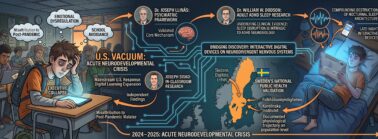
The Global ADHD/ASD Social-Media-Based Severe Sleep Deprivation Crisis
Bridging the 2024–2025 Clinical Discovery, Dr. Joseph Llinás’ Psychiatric Framework, Dr. William Dodson’s Adult ADHD Sleep Research, and Sweden’s National Public Health Validation The U.S. Vacuum and the 2024–2025 Discovery Between 2024 and 2025, an acute neurodevelopmental crisis escalated across American classrooms: adolescent students with Attention-Deficit/Hyperactivity Disorder (ADHD) and Autism Spectrum Disorder (ASD) experienced unprecedented […]

When Steve Jobs Predicted the Future of Neurodiversity: How the Tech Icon Foresaw Dr. William Dodson’s ADHD Framework and the Scandinavian School Reboot
In the late 1990s, Steve Jobs made a surprising admission. As the man who had put more personal computers into classrooms than perhaps anyone else in history, he publicly stated that technology was by no means the most important thing in education (Computerworld, 1996). "Computers are very reactive... What children need is something much more […]

The Neo-Basic Pivot: How Nordic Schools Are Countering Digital Dependency Through Analog Sanctuaries
For over a decade, Nordic education systems were held up as global benchmarks for digital integration. Laptops and tablets replaced paper, interactive apps supplanted physical textbooks, and classrooms became living laboratories for 1:1 screen-based learning. However, as international literacy scores slipped and public health agencies reported rising rates of youth anxiety, sleep deprivation, and fragmented […]

The Illusion of Inexpensive Electrons: The Financial Calculus Behind the K-12 Digital Conversion
Over the past decade, primary and secondary public education systems across North America underwent a structural transformation, shifting from physical textbooks to 1-to-1 digital device deployment. While this transition was often framed in pedagogical terms—promising "interactive engagement" and "personalized learning"—the foundational impulse driving school administrators was grounded in financial calculus. Educators and district CFOs were […]

The Unpiloted Pivot: How Scandinavia Reversed Hyper-Digital Education Without Sample School
Executive Summary When Sweden and Denmark executed their dramatic pivot away from screen-heavy instruction and back toward physical textbooks, handwriting, and phone bans in 2023, they did so without running formal, state-sponsored "sample school" or pilot trials. Instead of conducting a multi-year pilot program, Scandinavian policymakers treated the preceding decade of hyper-digitalisation as an unproven, large-scale […]
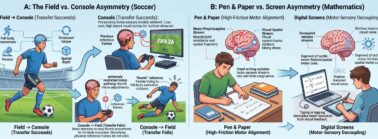
The Asymmetry of Learning: Sensorimotor Reference Frames in Mathematics and Physical Mastery
Executive Summary Modern educational technology operates on the implicit premise that digital interfaces—touchscreens, keyboards, and interactive software—are functional equivalents to physical, tactile interaction. However, advances in neocortical modeling (specifically Jeff Hawkins’ Thousand Brains Theory of Intelligence) and embodied cognitive neuroscience expose a fundamental flaw in this assumption: skill transfer between physical reality and digital simulation is strictly […]

The Nordic Digital Paradox: How Unfettered Screen Time Fractured Classrooms—and the “Neo-Basics” Pivot That Followed
For decades, the Nordic nations stood as the global benchmark for education and civic responsibility. Built on high social trust, robust funding, and a deep commitment to child development, their systems seemed nearly bulletproof. When these countries pioneered 1-to-1 technology initiatives—handing every student a laptop or tablet—the world assumed it was the dawn of a […]