
Article Archive

The Freedom of the Trade: When Nonlinear Brains Outgrow the K-12 Classroom
Traditional school systems are fundamentally built around a structural model that rewards sequential processing, compliance, delayed payoff, and relatively uniform pacing. For a student with a highly active, nonlinear ADHD brain, that environment can become a friction machine rather than a learning machine. Sit here. Do this now. Stop doing that. Hand this in Tuesday. […]
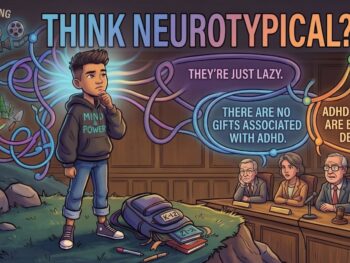
The Neuro-ESOL Imperative: Translating the Nonlinear Lattice of the ADHD Brain
There is already a precedent for what I am proposing. We train teachers to work with English-language learners because we understand something fundamental: a child can be intelligent, capable, curious, and ready to learn while still experiencing a profound educational impairment when the language of the classroom does not match the language the child can […]
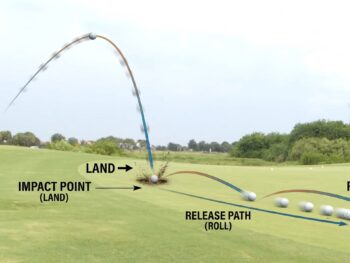
When to Remove the “u” in AuDHD to Master Performance in Golf
Traditional school systems are fundamentally built on a structural model that rewards sequential processing, conformity, and uniform paces. For a student with a highly active, nonlinear brain, the rigid environment of primary and secondary education often acts as a friction point rather than a catalyst for learning. When a high-IQ, hyperactive thinker checks out of […]
The Architect of Eternity Road: Justin Hayward’s Nonlinear Collaborative Blueprint
His working method within the Moody Blues was a masterclass in controlled surrender. He knew exactly how much of a song to dictate to keep it structurally sound, and exactly how much space to leave wide open so the other distinct brains in the room could work their magic. When you synthesize everything we've looked at, […]

Why Certain Individual Sports and “Island” Positions Are Sanctuaries for ASD Thinkers
For youth on the autism spectrum (ASD), team sports characterized by continuous, unpredictable social choreography (like basketball or soccer) can create an overwhelming cognitive load. However, individual sports and highly structured, isolated roles within larger sports provide an ideal canvas. These environments allow a rigid, systematic, and deeply focused brain to achieve mastery by turning […]
Of Stars and Synapses: Edo Berger, Dr. Dodson, and the War Against Legacy Thinking
When you map Edo Berger’s cosmic breakthrough against the struggles of pioneering clinical researchers, you see that the structural obstacles are identical. The difference is that astrophysics finally got its "quantum detectors," while behavioral science is still fighting to build its own. 1. The Shared Obstacle: Guarding the Invisible Castle Both Edo Berger and Dr. […]
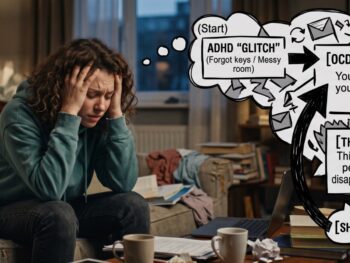
Beyond the 20,000 Negative Messages: The Perpetual Baggage of ADHD and OCD
1. The Baseline: ADHD and the "20,000 Negative Messages" The statistic you are referring to comes from Dr. William Dodson, who estimated that by age 12, children with ADHD receive roughly 20,000 more negative or corrective messages than neurotypical children. 2. The Multiplier: OCD's Intrusive Thoughts and "False Narratives" When you introduce OCD into the […]
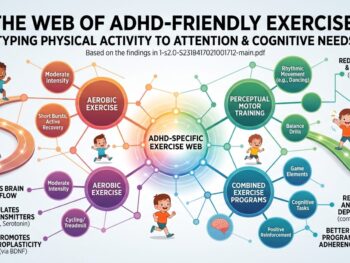
Effects of physical exercise on children with Attention Deficit Hyperactivity Disorder (ADHD)
This review article examines the role of physical exercise as an adjunctive, non-drug treatment for children and adolescents with Attention Deficit Hyperactivity Disorder (ADHD) . It synthesizes how both brief, single sessions (acute exercise) and regular, long-term programs (chronic exercise) impact the neurophysiology and cognitive functions of children dealing with the disorder . Key Highlights […]
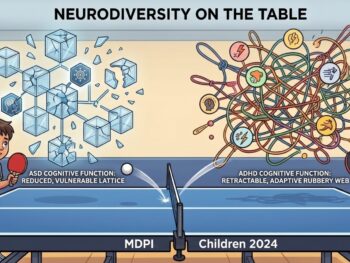
The Neurodivergent Arena: Singles vs. Doubles Table Tennis
For individuals navigating neurodivergence, sports are rarely just about physical exercise. They are an intense exercise in cognitive load management. While a sport like soccer introduces a massive, 21-vector matrix of chaotic human movement, table tennis shrinks the physical universe down to a highly predictable, $9 \times 5$ foot geometric surface. However, how a brain processes this […]
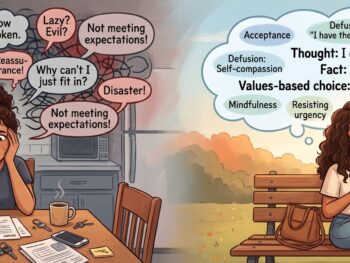
Treating the intersection of ADHD and OCD requires a highly deliberate, Modified Aproach of ERP
Treating the intersection of ADHD and OCD requires a highly deliberate, modified approach. Standard OCD treatment (like traditional ERP) can sometimes feel too rigid or under-stimulating for an ADHD brain, while standard ADHD coaching can accidentally feed into OCD compulsions—especially reassurance-seeking disguised as "problem-solving" or "checking." To break the shame loop without feeding the compulsion cycle, clinicians […]

Striking a Balance: How Rhythmic Bowling Mechanics Calm and Coordinate the Autistic Nervous System
In the context of sports, recreation, and adapted physical activity, bowling is often a highly recommended sport for individuals on the autism spectrum (ASD). However, standard delivery styles can sometimes feel mechanically rigid or sensory-jarring. The "rock the baby" approach—a specialized bowling delivery technique where the bowler cradles or swings the ball smoothly close to the body, emphasizing a […]

The Goalkeeper Paradox: High-Stakes Focus, Spatial Clarity, and the Multisport Advantage
The goalkeeper position in soccer is a fascinating paradox: it is an isolated, highly specialized role that requires intense psychological resilience, making it uniquely suited for an athlete with ADHD. While it is often viewed as a "wallflower" position because the keeper stands apart from the continuous, fluid movement of the rest of the team, […]
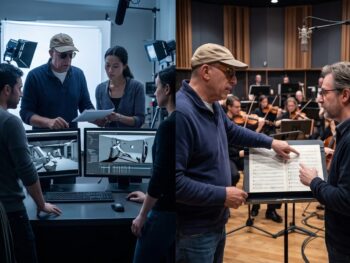
The Neurological Playground: Why Film Directing is the Ultimate Job for ADHD
For an ADHD mind, a traditional 9-to-5 desk job can feel like a sensory deprivation chamber. But a movie set? That is a high-stimulus, ever-changing environment where the unique traits of ADHD transition from "symptoms" into pure creative superpowers. By looking at how a film is built, structured, and executed, it becomes clear that the […]

Startup Captain to Middle Manager: Why ADHD Directors Thrive in Film but Suffice in TV
While feature filmmaking provides the ultimate playground for an ADHD mind, moving into episodic television often strips away those exact neurological safeguards. In the realm of TV shows, the power dynamic shifts entirely. The traits that make an ADHDer an intuitive, hyper-focused visionary in film can become major liabilities in television, largely because television is […]
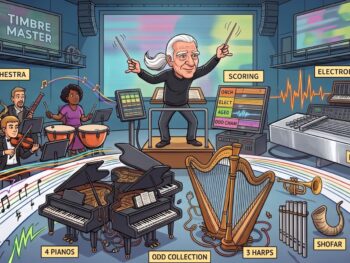
The Case of Jerry Goldsmith, the ADHD Progessive Film Composer.
If the movie set is the ultimate macro-playground for the ADHD mind, then the scoring stage—specifically the world inhabited by legendary composer Jerry Goldsmith—is its micro-equivalent. While many traditional composers found comfort in standard orchestral arrangements, Goldsmith treated every score like a brand-new, high-stimulus playground. His career is a textbook study in how an insatiable […]