
Article Archive

Stream-of-Consciousness and Sonic Caddies: Unpacking the ADHD Advantage in Animation
If a standard recording booth is a sensory deprivation chamber, a voice acting career is a high-stimulus, lightning-fast playground where ADHD traits translate into massive professional advantages. In the voiceover (VO) industry, the fast-paced transitions, high-energy demands, and microscopic focus loops make it an absolute paradise for a neurodivergent creative. Here is why the voice […]
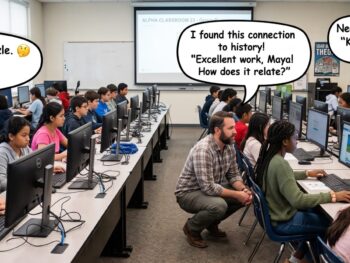
The Mirage of the Machine: Why Adaptive Learning Cannot Replace the Human Architecture of the Classroom
Modern education policy debates are fractured by a profound, structural contradiction. On one hand, boutique, highly resourced private micro-school models are lauded by administrations for their rapid, self-paced academic successes, often attributing their data entirely to cutting-edge, adaptive AI platforms. On the other hand, federal policy shifts consistently squeeze public education, cutting vital Title I […]

The Vector of Real Empathy: Why We Are Failing Neurodivergent Kids and How to Fix It
My former psychiatrist, Dr Joseph Llinas, is a two time APA man of the year for his clinical research on ADHD and ASD kids from low income families. One day I once asked him based on two people I know who had challenges with their ADHD kids the following question “What percentage of the problems […]

The Missing Variable in ADHD Education: Why True Advocacy is Still Missing in Our Schools
When Dr. William Dodson—a pioneer in adult ADHD research and the clinician who coined the term Rejection Sensitive Dysphoria (RSD)—reflects on a quarter-century of clinical practice, he doesn't point to a specific medication or a new organizational app as the ultimate key to thriving with ADHD. Instead, he points to a relationship. He points to […]
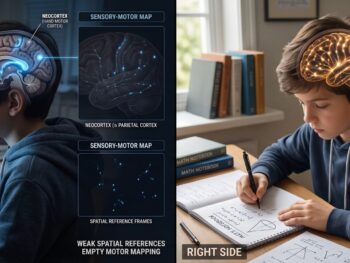
De-Evolving Intelligence: How AI Learning Starves the Human Neocortex
Jeff Hawkins’ Thousand Brains Theory of Intelligence—which details how the human neocortex operates as a distributed sensory-motor modeling system—provides a profound neuroscientific critique of modern AI-based learning models. When we look at how the brain evolved over millions of years to acquire knowledge, we find that intelligence is fundamentally embodied, predictive, and action-based. AI-based learning (passive screen […]
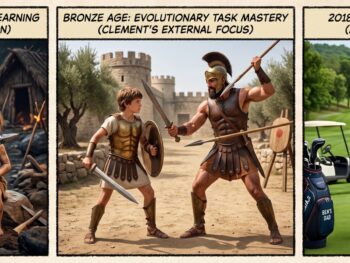
Back to the Hunt: Unlocking the ADHD Brain Through Tangible Tasks and Evolutionary Mechanics
When you overlay Jeff Hawkins' memory-prediction framework with Shawn Clement's task-focused, evolutionary golf mechanics, you get a perfect explanation for why the ADHD brain thrives on tangible, experiential learning. In fact, you can argue that the ADHD brain isn't "deficit" at all here; it is simply dialed directly into the ancient, highly efficient learning engine […]

The Ancestral Engine: Why the ADHD Brain Thrives in Craft, Trade, and Action
For decades, modern education and corporate culture have treated ADHD as a deficit of attention and executive function. Individuals with ADHD are frequently diagnosed as having "broken" internal wiring because they struggle to sit still for six hours, absorb abstract lectures, or organize their day using traditional planners and spreadsheets. However, when you strip away […]

The Instrument of the Mind: How Justin Hayward Forged Executive Function Through the Guitar
When examining the life of a master craftsman, the traditional boundaries between "disability" and "genius" completely dissolve. Justin Hayward, the celebrated frontman and songwriter of The Moody Blues, provides a textbook example of how a brilliant creative mind can forge deep, organic Executive Function (EF) entirely through a tool-based craft. By looking at his development […]
A Tale of Two Servants: Altruistic vs Self
When looking closely at the broader historical arc of ADHD research—culminating in Dr. Russell Barkley’s retirement and the formal recognition of emotional features in diagnostic manuals—we can see two fundamentally opposing advocacy arcs. These two arcs between Dr .Wiliam Dodson and Dr. Rusell Barkley represent a generational clash over how the ADHD brain is defined, […]

ADHD: The Necessity of Showing Rather Than Telling
The necessity of showing rather than telling is a foundational concept when collaborating with, coaching, or leading individuals with ADHD. Because abstract verbal instructions require a high degree of mental sequencing and working memory, concrete visual examples act as a cognitive bridge. The dynamics of this approach are illustrated by the basketball examples, the bakery analogy, and […]

John Chaney: A Model Mensch for Teachers of ADHDers in the Classroom
In college athletics, coaches are routinely judged by a ruthless calculus: wins, tournament appearances, and graduation rates. But the late, legendary Temple University basketball coach John Chaney operated on a different plane entirely. To Chaney, a basketball court wasn't just an arena for sport; it was a classroom, a sanctuary, and—most importantly—the home of a […]

The Invisible Hurdle: Why Elite Argentine Athletes Face an Uphill Battle for ADHD Diagnosis
While Emiliano Martínez is one of the most vocal advocates for mental health in modern football, his public discussions regarding his psychological health have focused entirely on managing high-pressure stress, emotional regulation, and performance anxiety. He works intensely with his personal psychologist multiple times a week to stay focused during high-stakes matches and navigate the […]

Channelling Hyperfocus: How Brazil Navigates Anti-Doping and Support for World Cup Athletes with ADHD
When looking at how Brazil approaches support for athletes with Attention Deficit Hyperactivity Disorder (ADHD), the landscape spans strict anti-doping regulations, high-performance coaching, and a deep cultural reliance on highly structured sports like Brazilian Jiu-Jitsu (BJJ) as therapeutic frameworks. Here is a breakdown of how the intersection of neurodiversity and athletics functions in Brazil today. […]

The Hyperfocus Edge: What US Classrooms Can Learn from Brazilian Sports Psychology
When looking at how Brazil approaches support for athletes with Attention Deficit Hyperactivity Disorder (ADHD), the landscape spans strict anti-doping regulations, high-performance coaching, and a deep cultural reliance on highly structured sports like Brazilian Jiu-Jitsu (BJJ) as therapeutic frameworks. But the most revolutionary element of the Brazilian model lies in its elite soccer academies. While […]

The Implementation Gap: Why Brazil’s Sports Psychology Triumphs Fail to Reach the K-12 Classroom
While the sports science and martial arts communities in Brazil have built structured, proactive environments to channel the ADHD brain, the transition into the traditional classroom environment is much more complicated. There is a distinct gap between Brazil’s sweeping legal frameworks, its elite athletic systems, and the daily realities of its public and private schools. […]