ADHD ESCAPE ROOM

How Unlocked School Laptops Stole Our Children’s Sleep

ADHD ESCAPE ROOM

Electronic Devices and The Loss of Formative Play

ADHD ESCAPE ROOM

Flipping the Script on Dr. Russell Barkley & Executive Functions Deficits

ADHD ESCAPE ROOM

The Hubris of the Lab Bench: Why ADHD Science Needs a "Reboot"

ADHD ESCAPE ROOM

The Missed Steve Jobs Story: Path to Empathy

01

Build Awareness of Trauma's Role in Impairing ADHDers in the Classroom

Recognizing how past trauma and neurodivergence intersect is vital for creating safe, understanding learning environments where students aren't just managed, but genuinely supported.

02

Target the Institutional Failures in Supporting and Nuturing ADHDers

Examining how systemic breakdowns across schools, home life, and adult psychiatric care consistently fail neurodivergent individuals by demanding neurotypical conformity instead of providing real structural support.

03

Celebrate where ADHDers Fit, Excell and Everthing Flows

Shifting the narrative toward hyperfocus, creativity, and natural strengths allows ADHD individuals to thrive in spaces tailored to how their minds work.

"A child’s worst fears are that they are unlovable (because they are broken in some way) and they are going to be abandoned with a problem they cannot fix, no matter how hard they try. If a child knows that you see the potential for greatness in them, they will walk through Hell for you to deliver that greatness."


Dr. William Dodson LF-APA

Institutional

Failures

ADHD Escape Room exposes how widespread institutional failures—spanning academic research, poorly trained clinicians and teachers, and rigid systemic policies—trap individuals in a destructive cycle of misunderstanding, criticism, and shame instead of offering true support. Rather than just navigating standard school rules, neurodivergent people face an environment where institutional shortcomings turn ordinary neurological differences into years of conflict and needless trauma. When researchers, educators, and mental health professionals repeatedly fail to understand the actual wiring of the brain in front of them, the resulting alienation drives many ADHDers to check out of traditional treatment entirely and turn instead to self-medication and unproven remedies.
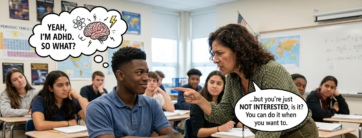

The Accidental Diagnosis: How the ADHD Binary Toggle Invites 20,000 Scars of Academic Trauma
One of the most agonizing, systemic disconnects in modern education lies at the intersection of neurodiversity and classroom management. By contrasting the ADHD binary toggle with the continuous expression of Autism Spectrum Disorder (ASD), we can pinpoint exactly why the ADHD brain bears such a disproportionate weight of moral judgment, gaslighting, and academic trauma. The statistics are devastatingly […]
The Chemical Straightjacket: Tracking the Shadow Arc of an ADHD Brain Misdiagnosed with Bipolar Type I
When pop star Demi Lovato revealed in her 2021 docuseries that she had been misdiagnosed with Bipolar Disorder—and actually had ADHD—it cast a stark light on an incredibly common psychiatric crossroads. For over a decade, her public narrative was built around the relief, and subsequent struggle, of treating a severe mood disorder. Without assuming or […]
How Systemic Failures Lead to the Ultimate Escape Room: Prison
When these specific, acute layers of trauma—sexual assault, physical assault, and witnessing chronic violence at home, in the neighborhood, and/or at school—are forced onto an undiagnosed ADHD brain, the institutional pipeline accelerates with terrifying velocity. For a child navigating these horrors, the brain is not just under-stimulated; it is profoundly, constantly terrorized. Adding these layers of […]
ADHD Health: The Cognitive Dangers of Benadryl as a Sleep Aid.
Using Benadryl (diphenhydramine) as a nightly sleep aid is a common desperation move for anyone struggling with insomnia, but for an ADHD brain, it is a uniquely counterproductive strategy. While it might knock you out temporarily, the underlying neurochemistry of diphenhydramine directly sabotages the exact brain networks an ADHDer needs to function the next day. […]

25%

Despite its prevalence, only 10-25% of adults with ADHD receive an accurate diagnosis and adequate treatment. Women with ADHD face unique challenges. Many are misdiagnosed or undertreated, often receiving antidepressants instead of appropriate ADHD treatment. This gap in care represents a significant public health challenge.

Trauma

Unresolved trauma fundamentally alters neurodevelopment and hijacks the brain's predictive processing systems, locking the nervous system in a chronic state of threat detection where higher-order cognitive processing, working memory consolidation, and deep learning become biologically inaccessible. When a child or adult with ADHD faces cumulative developmental trauma from chronic criticism and rejection, their brain prioritizes immediate emotional self-preservation over exploratory curiosity—transforming the classroom, workplace, or any environment requiring vulnerability and potential failure into a zone of high-stakes danger rather than a space for skill acquisition.

Dr. Russell Barkley

Dr. Russell Barkley’s disproportionate influence on ADHD thinking in the 2000s helped focus the field heavily on executive-function deficits. That influence also impaired the flow of research into a critical question: how childhood trauma changes the developmental trajectory of an ADHD child into adulthood.

It also left another population largely unexplored: ADHD adults who thrived, often diagnosed in their forties after their children were diagnosed. Some had supportive homes, schools that fit them, and no childhood experiences that would be classified as trauma. They learned to ask for help, compensate, and build scaffolding where their ADHD brains needed it.


They still had ADHD. But they were never fighting themselves or their past. Studying these adults alongside ADHD adults who experienced childhood trauma could help separate what belongs to ADHD itself from what emerges through the interaction of ADHD, trauma, and environment.


Athletics

Academic ADHD research remains trapped behind a pathological lens that treats sports merely as a clinical management tool rather than a profound model of cognitive flourishing. By ignoring the vast repository of elite athletic performances where fast-paced, high-stakes environments naturally optimize kinesthetic and sensorimotor decision-making, researchers miss how the ADHD brain achieves peak operational flow. Platforms like ADHDEscapeRoom.com actively challenge this academic oversight by spotlighting sports as a natural haven for thriving, compelling the scientific community to shift its gaze from deficit checklists to the mechanics of high-performance success.


The Case of an ADHD “Michelin Star Mind” and Unfettered Rejection Sensitive Dysphoria (RSD).
The Michelin Star Mind in the Quiet of Real Life: Understanding RSD When you take the "Michelin Star Mind" out of the high-heat environment and drop them into interpersonal relationships, that social friction is very often driven by unfettered Rejection Sensitive Dysphoria (RSD). RSD is an intense, agonizing emotional vulnerability to the perception—not necessarily the reality—of […]
Michael Vick: From the Miracle in the Meadowlands to a Miracle He’s Alive
On December 19, 2010, the New York Giants had the Philadelphia Eagles buried. With just under eight minutes left in the fourth quarter, the Giants held a commanding 31-10 lead. The home crowd in East Rutherford was already celebrating. Then, Michael Vick went completely nuclear. What followed was eight minutes of pure, unadulterated sports sorcery. […]
Non-Linear Genius: How Magic Johnson and Albert Einstein Mapped the Future
Comparing Magic Johnson’s court vision to Albert Einstein’s discovery of relativity reveals a fascinating parallel in how genius operates. Both men possessed a cognitive superpower: the ability to abandon rigid, linear viewpoints and instead map how space, time, and relative motion interact as a single fluid system. Einstein didn't discover relativity through abstract math alone; he did […]
The Rule 5 Illusion: Why Four Teams Failed Shane Victorino (And How Charlie Manuel Saved Him)
The story of Charlie Manuel and Shane Victorino is a masterclass in how rigid, "hyper-linear" industrial systems fail neurodivergent brilliance, and how an empathetic, non-linear leader can unlock a borderline legendary career. To understand why other teams failed "The Flyin' Hawaiian," you have to look at the mechanical conveyor belt of baseball development. 1. How the Linear System Failed […]

Latest Posts

The Compositionality Crisis: Why AI Image Generation Struggles with Geometry and the “Thousand Brains” Fix
Modern text-to-image AI models—such as Midjourney, Stable Diffusion, and DALL-E—can generate stunning, hyper-realistic imagery at the click of a button. Yet, despite their artistic flair, these generators frequently suffer from bizarre, immersion-breaking structural failures. Ask an AI to draw a person holding a coffee mug, and the hand might clip through the porcelain, the handle […]
The Irony of Innovation: How Norway Reengineered Brazil’s Street-Play Advantage
For nearly a century, Brazil stood as the undisputed global superpower of soccer. Its secret weapon was never a state-of-the-art training complex, corporate sponsorship, or a rigid tactical playbook. It was futebol de rua—street football. Within the favelas and urban avenues of Brazil, children spent hours playing unsupervised on uneven cobblestones, beaches, and narrow alleyways. This […]
The Architecture of Childhood: How Norway is Reclaiming the Formative Years
While the rest of the world rushes to accelerate childhood—substituting algorithms for teachers and turning elementary school recess into pressure-cooker sports academies—Norway has quietly launched a counter-revolution. In a pair of structural moves, the Nordic nation has drawn a line in the sand to protect the sacred window of development up to age twelve. By enforcing […]
Mapping the World: Why Norway’s Ban on School AI is a Triumph of Neuroscience
When Norway announced a sweeping ban on generative AI for grades 1 through 7 alongside a massive reinvestment in physical textbooks, tech-optimists balked. To the Silicon Valley crowd, it looked like luddite regression—a stubborn refusal to prepare children for an automated future. But if you look past the political headlines and examine the architecture of […]
The Cost of a Clean House: Why Norway’s No-Scoreboards Rule Protects the Scientist Inside Every Child
When we think about early childhood athletic programs, we usually frame them around physical health, teamwork, or letting kids blow off steam. But if you watch astrophysicist Neil deGrasse Tyson talk about how children actually learn, you realize that play isn't a break from education—it is the highest form of science a child can perform. […]
The “CSI Geology” Framework: Why Hands-On Experiential Science Matches Norway’s Educational Philosophy
If you want to see what Norway’s national educational policies look like when translated into a single, concrete curriculum, you don’t look at a standard textbook. You look at an interactive, investigative model like a "CSI Geology"classroom. Norway’s systemic push to ban generative AI in primary grades and eliminate high-stakes, outcome-based pressure isn't just about stepping […]
The Collaboration Dividend: How Cross-Disciplinary Architecture Cures Teacher Isolation
The absolute worst place to be in a modern school is alone in your own room. The traditional school structure doesn't just slice up a student's day; it actively isolates the faculty. A math teacher spends months grinding through algebraic equations, completely unaware that the history teacher three doors down is struggling to explain the […]
The Kinetic Stratigraphy: Decoding Elite ADHD Performance from the Broadcast Archive
If a volcanologist uses ice core samples to read centuries of atmospheric shifts and pressure spikes, then the thousands of hours of tape on elite ADHD athletes—from game film to raw post-match press conferences—is a living, breathing stratigraphy of neurodivergent human performance under extreme duress. It is a data set hiding in plain sight. Yet, […]
The Accidental Remedy: Why Injured Athletes Suddenly “Develop” ADHD
"...Two years ago there was nothing at all about the effects of aerobic exercise on ADHD. I had worked with dozens of people. Of course, who have treated their ADHD with exercise (the trade-off is one hour of aerobic exercise for 4 hours of performance that is at least the equal of stimulant medications). I […]

Advocates

Joseph Sisko

Creative Director and ADHD Advocate

Dr William Dodson

ADHD Mental Health Advocate

Maryann Theadora

Leed Empath

Benjamin Sisko

Defiant Captain

Legal & Educational Disclaimer

1. Educational and Informational Purposes Only The content provided on this website—including articles, frameworks, graphics, podcast episodes, and apparel concepts—is for informational, educational, and advocacy purposes only. It is intended to highlight alternative learning insights and neurodivergent potential. It is not a substitute for professional medical or psychological advice, diagnosis, or treatment.

2. Anecdotal Evidence and Comorbidities The personal stories, field experiences, and strategies shared here represent anecdotal evidence showcasing the potential of individuals with ADHD, AuDHD, and ASD. These accounts are presented without any warranty or guarantee of specific outcomes. Because the behavioral science profession frequently navigates a multitude of complex, underdiagnosed comorbidities, what works for one individual may not apply to another.

3. No Professional Relationship Your use of this website, or your interaction with any associated materials, does not create a professional-client, therapist-patient, or advisory relationship.

4. Seek Professional Advice Always seek the advice of your physician, licensed therapist, or other qualified healthcare provider with any questions you may have regarding a medical or mental health condition. Never disregard professional medical advice or delay in seeking it because of something you have read on this platform.

5. Limitation of Liability By utilizing the information, concepts, or tools discussed on this website, you voluntarily agree that you are doing so at your own risk. The creators and affiliates of this platform assume no responsibility or liability for any consequence resulting directly or indirectly from any action or inaction you take based on the information provided.

6. Crisis Notice This website is not a crisis monitoring resource. If you or someone you know is struggling with a mental health crisis, please contact your local emergency services (such as dialing 988 or 911 in the U.S.) or go to the nearest emergency room immediately.