ADHD ESCAPE ROOM: SCHOOL REBOOT

The School Provided Laptop HAS BEEN the Trojan Horse All Along

ADHD ESCAPE ROOM

Electronic Devices and The Loss of Formative Play

ADHD ESCAPE ROOM: SCHOOL REBOOT

The Scandanavian Reboot: Neo Basics

ADHD ESCAPE ROOM

The Latest Pandemic: Social-Media-Based Sleep Deprivation!

01

Deconstruct the Myths of Digital-First "Innovation

Exposing how screen-based learning and EdTech pushed mass digitalization at the expense of hands-on, kinesthetic, and human-centered development.

02

Prioritize Kinesthetic and Sensorimotor Foundations

Championing learning environments rooted in physical engagement, environmental interaction, and real-world feedback loops rather than passive screen consumption

03

Rebuild Systemic Architectures Around Natural Cognition

Designing educational frameworks that align with how the human brain actually develops and learns, turning away from rigid compliance models toward true developmental support

“We have learned that the digitalization, the educational technology does not uplift quality and equity of education systems….and I think, you know, it's not only my opinion, but whatever way you look at the research evidence, the conclusion is that it has been, indeed, a wrong way, a wrong direction to try to improve education systems. “


Dr Pasi Sahlberg, Finland

Rebooting

Education

Sweden and the Los Angeles Unified School District transitioned away from ubiquitous 1-to-1 device models to correct the academic drift caused by uncritical, screen-heavy mandates. Sweden reallocated substantial funding to physical textbooks, handwriting instruction, and printed literature to rebuild foundational literacy and cognitive stamina, particularly after national data highlighted the negative impacts of early digital saturation. Similarly, LAUSD recalibrated its device policy by restricting daily screen time, eliminating take-home technology mandates for younger grades, and scaling back default digital platforms that fragmented attention.


Crucially, this return to neo-basics does not signal a retreat into passive, rote memorization or rigid 19th-century instruction. Instead, these systems are leveraging the removal of individual screens to re-energize active, tactile pedagogies—most notably Finland’s phenomenon-based learning and robust project-based frameworks. By establishing a stable, screen-free baseline of physical literacy and analog tools, educators are finding that students can engage more deeply in collaborative, multidisciplinary, and hands-on inquiry without the cognitive friction and distraction inherent to constant device dependency.


The Illusion of Inexpensive Electrons: The Financial Calculus Behind the K-12 Digital Conversion
Over the past decade, primary and secondary public education systems across North America underwent a structural transformation, shifting from physical textbooks to 1-to-1 digital device deployment. While this transition was often framed in pedagogical terms—promising "interactive engagement" and "personalized learning"—the foundational impulse driving school administrators was grounded in financial calculus. Educators and district CFOs were […]
The Unpiloted Pivot: How Scandinavia Reversed Hyper-Digital Education Without Sample School
Executive Summary When Sweden and Denmark executed their dramatic pivot away from screen-heavy instruction and back toward physical textbooks, handwriting, and phone bans in 2023, they did so without running formal, state-sponsored "sample school" or pilot trials. Instead of conducting a multi-year pilot program, Scandinavian policymakers treated the preceding decade of hyper-digitalisation as an unproven, large-scale […]
The Asymmetry of Learning: Sensorimotor Reference Frames in Mathematics and Physical Mastery
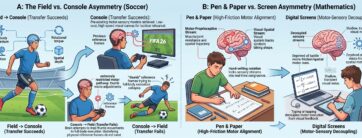
Executive Summary Modern educational technology operates on the implicit premise that digital interfaces—touchscreens, keyboards, and interactive software—are functional equivalents to physical, tactile interaction. However, advances in neocortical modeling (specifically Jeff Hawkins’ Thousand Brains Theory of Intelligence) and embodied cognitive neuroscience expose a fundamental flaw in this assumption: skill transfer between physical reality and digital simulation is strictly […]
The Nordic Digital Paradox: How Unfettered Screen Time Fractured Classrooms—and the “Neo-Basics” Pivot That Followed
For decades, the Nordic nations stood as the global benchmark for education and civic responsibility. Built on high social trust, robust funding, and a deep commitment to child development, their systems seemed nearly bulletproof. When these countries pioneered 1-to-1 technology initiatives—handing every student a laptop or tablet—the world assumed it was the dawn of a […]

5 hours

Parents trusted school-issued devices as safe, sanctioned educational tools, completely unaware that they functioned as digital Trojan horses granting round-the-clock access. Because schools endorsed the technology, families permitted unrestricted home use under the assumption it was secure and beneficial. However, this 24/7 connectivity kept children engaged deep into the night with notifications, streaming, and social media, systematically dismantling natural rest cycles. Consequently, student sleep averages plummeted to a critical low of just five hours a night.

Trauma

Unresolved trauma fundamentally alters neurodevelopment and hijacks the brain's predictive processing systems, locking the nervous system in a chronic state of threat detection where higher-order cognitive processing, working memory consolidation, and deep learning become biologically inaccessible. When a child or adult with ADHD faces cumulative developmental trauma from chronic criticism and rejection, their brain prioritizes immediate emotional self-preservation over exploratory curiosity—transforming the classroom, workplace, or any environment requiring vulnerability and potential failure into a zone of high-stakes danger rather than a space for skill acquisition.

The Anatomy of an Edge: Kurt Cobain, ADHD, and the Physics of Rejection
Kurt Cobain remembered the dividing line. There was the childhood before his parents divorced, and there was everything that came after it. “I had a really good childhood, until the divorce,” he recalled as an adult. Afterward, his “whole world” changed. He remembered the shame of coming from a broken family and desperately wanting the […]

Brandy Tackett

I am a career educator and school principal with more than 2 decades of experience leading high-needs and turnaround schools as a teacher, instructional coach, assistant principal, and principal.


My work centers on emotionally intelligent leadership, authentic culture-building, and sustainable school improvement — especially in environments where trust has been broken, morale is fragile, and expectations are high.


I am the author of Emotionally Intelligent School Leadership: Lead with Heart, Transform with Purpose (Routledge | Eye on Education, releasing March 2026), a practitioner-rooted framework drawn from real schools, real challenges, and real leadership moments. The book is already being distributed internationally and reflects my belief that transformation happens when leaders prioritize people, clarity, and accountability together.

Rebooting Education: Neo-Basics

The Play Deficit and ADHD: Why the Loss of Unstructured Play Has Made Adolescent RSD More Explosive Than Ever
For decades, researchers and parents have struggled to comprehend the escalating mental health crisis among teenagers. In adolescents with Attention Deficit Hyperactivity Disorder (ADHD), this crisis frequently manifests as an overwhelming, paralyzing state known as Rejection Sensitive Dysphoria (RSD). Characterized by extreme, unbearable emotional pain triggered by perceived or actual rejection, teasing, or failure, RSD was […]
The Divergence of Intelligence: Why True AI Will Never Duplicate Human Mind, but That’s Not the Goal
When Silicon Valley evangelists predict that an artificial general intelligence (AGI) built on Jeff Hawkins’s Thousand Brains Theory will eventually "duplicate" the human mind, they commit a fundamental systems-architecture error. They treat the neocortex as an isolated software package that can be copied paste-style from carbon into silicon. But as we have established throughout this repository, intelligence […]
The Social Architecture: Reclaiming Relational Intelligence Through Spatial Synchrony
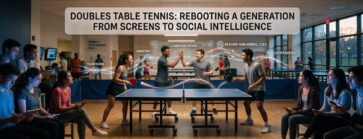
The digital destruction of the "lost generation" extends far beyond the decay of individual cognitive focus; it has systematically dismantled the biological substrate of social intelligence. In a screen-mediated world, human interaction has been stripped of its physical geometry. Socialization has been reduced to flat text, static images, and asynchronous video feeds. When a developing […]
The Irony of Innovation: How Norway Reengineered Brazil’s Street-Play Advantage
For nearly a century, Brazil stood as the undisputed global superpower of soccer. Its secret weapon was never a state-of-the-art training complex, corporate sponsorship, or a rigid tactical playbook. It was futebol de rua—street football. Within the favelas and urban avenues of Brazil, children spent hours playing unsupervised on uneven cobblestones, beaches, and narrow alleyways. This […]
The Architecture of Childhood: How Norway is Reclaiming the Formative Years
While the rest of the world rushes to accelerate childhood—substituting algorithms for teachers and turning elementary school recess into pressure-cooker sports academies—Norway has quietly launched a counter-revolution. In a pair of structural moves, the Nordic nation has drawn a line in the sand to protect the sacred window of development up to age twelve. By enforcing […]
Mapping the World: Why Norway’s Ban on School AI is a Triumph of Neuroscience
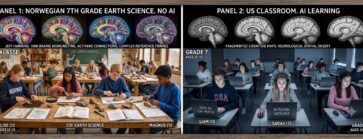
When Norway announced a sweeping ban on generative AI for grades 1 through 7 alongside a massive reinvestment in physical textbooks, tech-optimists balked. To the Silicon Valley crowd, it looked like luddite regression—a stubborn refusal to prepare children for an automated future. But if you look past the political headlines and examine the architecture of […]
The Cost of a Clean House: Why Norway’s No-Scoreboards Rule Protects the Scientist Inside Every Child
When we think about early childhood athletic programs, we usually frame them around physical health, teamwork, or letting kids blow off steam. But if you watch astrophysicist Neil deGrasse Tyson talk about how children actually learn, you realize that play isn't a break from education—it is the highest form of science a child can perform. […]
The “CSI Geology” Framework: Why Hands-On Experiential Science Matches Norway’s Educational Philosophy
If you want to see what Norway’s national educational policies look like when translated into a single, concrete curriculum, you don’t look at a standard textbook. You look at an interactive, investigative model like a "CSI Geology"classroom. Norway’s systemic push to ban generative AI in primary grades and eliminate high-stakes, outcome-based pressure isn't just about stepping […]
The Collaboration Dividend: How Cross-Disciplinary Architecture Cures Teacher Isolation
The absolute worst place to be in a modern school is alone in your own room. The traditional school structure doesn't just slice up a student's day; it actively isolates the faculty. A math teacher spends months grinding through algebraic equations, completely unaware that the history teacher three doors down is struggling to explain the […]