ADHD ESCAPE ROOM

Electronic Devices and The Loss of Formative Play

ADHD ESCAPE ROOM

Flipping the Script on Dr. Russell Barkley & Executive Functions Deficits

ADHD ESCAPE ROOM

The Hubris of the Lab Bench: Why ADHD Science Needs a "Reboot"

ADHD ESCAPE ROOM

The Latest Pandemic: Social-Media-Based Sleep Deprivation!

ADHD ESCAPE ROOM

The Missed Steve Jobs Story: Path to Empathy

Dr. Dodson Quotes

Dr. William Dodson

ADHD Servant Leader

"Most people get either poorly treated and/or humiliated by the process that less than 25% of people who are seen by a clinician are still involved in any treatment at the end of one year. The only thing that will change this will be a very public malpractice suit for negligent care (or, more likely, no care at all) that will jolt docs out of their complacency."

Sisko Quotes

Jose
Jose Sisko

ADHD Advocate

"Dr. Russel Barkley cannot be blamed for coining the term emotional dysregulation (ED)

which has been bouncing around the psychiatric literature for at least a decade, searching for a definition. Merely claiming the concept as an executive function deficit (EFD) does not make it one."

Dr. Dodson Quotes

Dr. William Dodson

ADHD Servant Leader

"A child’s worst fears are that they are unlovable (because they are broken in some way) and they are going to be abandoned with a problem they cannot fix, no matter how hard they try. If a child knows that you see the potential for greatness in them, they will walk through Hell for you to deliver that greatness.

Sisko Quotes

Jose
Jose Sisko

ADHD Advocate

"In 2019, the European Network Adult ADHD issued a Consensus Guideline that set forth adult ADHD diagnostic criteria for the very 1st time. The really big change was that the EU finally added emotions to the behavioral features that had constituted the diagnostic criteria up to that time. It should be noted that the US organization that prevented adult criteria more than any other (ABSARD) for 20 years was headed by Dr. Barkley."

Dr. Dodson Quotes

Dr. William Dodson

ADHD Servant Leader

"Some in my profession view people who have an ADHD style nervous system as being Neurotypical people who are damaged or deficient (without any apparent awareness of how hostile that attitude is)."

Latest Posts

The Parking Lot Paradox: A Case Study in Attentional Overwrite vs. Working Memory Deficits
It is a scenario familiar to countless individuals with ADHD: You walk out of a shopping center, stand on the concrete apron of a massive parking lot, and realize you have absolutely no idea where you left your car. Standard neuropsychological frameworks routinely point to this exact moment as textbook evidence of a working memory deficit. […]
The Distress Flare in the Margin: What “Master Doodlers” Reveal About ADHD Working Memory and the Fight Against Digital Exhaustion
Walk into any high school math classroom, university lecture hall, or corporate boardroom, and you will find them: the margins of notebooks, the back pages of agendas, and scrap pieces of paper covered in intricate, repeating geometric patterns, complex caricatures, or deeply shaded landscapes. Standard educational and clinical models have long labeled this behavior a […]
The Mirage of the “Broken Brain”: Why PFC Density Deficits are a Misleading Metric for ADHD
For decades, mainstream ADHD discourse—spearheaded by figures like Dr. Russell Barkley—has relied heavily on a deficit-based, biologically deterministic model. This framework frequently points to structural neuroimaging studies revealing a 3% to 10% reduction in prefrontal cortex (PFC) volume or gray matter density in individuals diagnosed with ADHD. The narrative built around this data is simple, clean, […]
The Mirror, the Tightrope, and the Anchor: Why Reaching ADHD Kids with Trauma Requires Us to Step Across the Line
Every teacher and parent of a neurodivergent child eventually finds themselves standing at the edge of a massive, unspoken divide. On one side is the rigid, clinical world of expectations, rules, and "standard" behavior. On the other side is the chaotic, brilliant, and deeply sensitive reality of the ADHD mind. To bridge this gap, adults […]
The Case of the Synesthetic Architect: How Brian Tyler’s AuDHD Savantism Redefines the Hollywood Soundscape
When listening to a sweeping cinematic score, most people experience a wave of emotion, a sense of scale, or a sudden spike in adrenaline. But for a select group of neurodivergent minds, a musical arrangement is not just an auditory experience—it is a physical, vibrating space pulsing with shape, texture, and a vivid explosion of […]
The Divergence of Intelligence: Why True AI Will Never Duplicate Human Mind, but That’s Not the Goal
When Silicon Valley evangelists predict that an artificial general intelligence (AGI) built on Jeff Hawkins’s Thousand Brains Theory will eventually "duplicate" the human mind, they commit a fundamental systems-architecture error. They treat the neocortex as an isolated software package that can be copied paste-style from carbon into silicon. But as we have established throughout this repository, intelligence […]
The Tulip Mania of EdTech: Why Classrooms Need Thinkers, Not “Fancy Calculators”
The cultural narrative surrounding artificial intelligence in education has reached a fever pitch. Venture capitalists, tech evangelists, and school district administrators frequently speak of Large Language Models (LLMs) as if they are omniscient digital tutors poised to completely restructure, run, and revolutionize the modern classroom. We are told that personalized algorithms will soon replace the […]
The Great Evolutionary De-Training: How Screens Are Unlearning 2 Million Years of Human Intelligence
There is a quiet, neurological crisis unfolding in the modern classroom, and it has nothing to do with curriculum standards, funding cuts, or standardized testing. It is a biological crisis. We are witnessing a massive, unprecedented evolutionary mismatch happening in real time. For nearly two million years, hominid survival depended on a highly sophisticated visual hunting, gathering, […]
Shared Reference Frames and the Geometry of the Doubles Loop
If the individual game of table tennis is a tactical force-reboot of the child’s individual 3D sensory-motor loop, then the introduction of doubles play is a profound upgrade to the system architecture. It transforms a hyper-focal, internal recovery process into a dynamic, real-time socio-spatial network. In the digital landscape, the screen strips away the spatial mapping of […]

Education Rebooting for this Generation

The Implementation Gap: Why Brazil’s Sports Psychology Triumphs Fail to Reach the K-12 Classroom
While the sports science and martial arts communities in Brazil have built structured, proactive environments to channel the ADHD brain, the transition into the traditional classroom environment is much more complicated. There is a distinct gap between Brazil’s sweeping legal frameworks, its elite athletic systems, and the daily realities of its public and private schools. […]
The Hyperfocus Edge: What US Classrooms Can Learn from Brazilian Sports Psychology
When looking at how Brazil approaches support for athletes with Attention Deficit Hyperactivity Disorder (ADHD), the landscape spans strict anti-doping regulations, high-performance coaching, and a deep cultural reliance on highly structured sports like Brazilian Jiu-Jitsu (BJJ) as therapeutic frameworks. But the most revolutionary element of the Brazilian model lies in its elite soccer academies. While […]
Channelling Hyperfocus: How Brazil Navigates Anti-Doping and Support for World Cup Athletes with ADHD
When looking at how Brazil approaches support for athletes with Attention Deficit Hyperactivity Disorder (ADHD), the landscape spans strict anti-doping regulations, high-performance coaching, and a deep cultural reliance on highly structured sports like Brazilian Jiu-Jitsu (BJJ) as therapeutic frameworks. Here is a breakdown of how the intersection of neurodiversity and athletics functions in Brazil today. […]
John Chaney: A Model Mensch for Teachers of ADHDers in the Classroom
In college athletics, coaches are routinely judged by a ruthless calculus: wins, tournament appearances, and graduation rates. But the late, legendary Temple University basketball coach John Chaney operated on a different plane entirely. To Chaney, a basketball court wasn't just an arena for sport; it was a classroom, a sanctuary, and—most importantly—the home of a […]
ADHD: The Necessity of Showing Rather Than Telling
The necessity of showing rather than telling is a foundational concept when collaborating with, coaching, or leading individuals with ADHD. Because abstract verbal instructions require a high degree of mental sequencing and working memory, concrete visual examples act as a cognitive bridge. The dynamics of this approach are illustrated by the basketball examples, the bakery analogy, and […]
The Instrument of the Mind: How Justin Hayward Forged Executive Function Through the Guitar
When examining the life of a master craftsman, the traditional boundaries between "disability" and "genius" completely dissolve. Justin Hayward, the celebrated frontman and songwriter of The Moody Blues, provides a textbook example of how a brilliant creative mind can forge deep, organic Executive Function (EF) entirely through a tool-based craft. By looking at his development […]
The Ancestral Engine: Why the ADHD Brain Thrives in Craft, Trade, and Action
For decades, modern education and corporate culture have treated ADHD as a deficit of attention and executive function. Individuals with ADHD are frequently diagnosed as having "broken" internal wiring because they struggle to sit still for six hours, absorb abstract lectures, or organize their day using traditional planners and spreadsheets. However, when you strip away […]
Back to the Hunt: Unlocking the ADHD Brain Through Tangible Tasks and Evolutionary Mechanics
When you overlay Jeff Hawkins' memory-prediction framework with Shawn Clement's task-focused, evolutionary golf mechanics, you get a perfect explanation for why the ADHD brain thrives on tangible, experiential learning. In fact, you can argue that the ADHD brain isn't "deficit" at all here; it is simply dialed directly into the ancient, highly efficient learning engine […]
De-Evolving Intelligence: How AI Learning Starves the Human Neocortex
Jeff Hawkins’ Thousand Brains Theory of Intelligence—which details how the human neocortex operates as a distributed sensory-motor modeling system—provides a profound neuroscientific critique of modern AI-based learning models. When we look at how the brain evolved over millions of years to acquire knowledge, we find that intelligence is fundamentally embodied, predictive, and action-based. AI-based learning (passive screen […]

Where ADHDers Thrive

The Freedom of the Trade: Why Nonlinear ADHD Brains Outgrow the K-12 Classroom
Traditional school systems are fundamentally built on a structural model that rewards sequential processing, conformity, and uniform paces. For a student with a highly active, nonlinear brain, the rigid environment of primary and secondary education often acts as a friction point rather than a catalyst for learning. When a high-IQ, hyperactive thinker checks out of […]
Evaluating Frank Lloyd Wright’s life through the lens of neurodivergence.
While we cannot issue a retroactive clinical diagnosis, looking at Wright's documented behavioral patterns reveals a textbook profile of AuDHD—the specific, complex intersection of Attention Deficit Hyperactivity Disorder (ADHD)and Autism Spectrum Condition (ASC). The dual nature of AuDHD creates a fascinating internal paradox: the autistic side craves intense geometric order, deep systemic logic, and hyper-fixated predictability, while […]
The Case for The Biological Engineers: Why the Orthopedic Operating Room is a Magnet for AuDHD and Neurodivergent Minds
To the outside observer, an orthopedic operating room can look and sound like a controlled construction site. There is the rhythmic hum of monitors, the precise clink of surgical steel, the forceful drive of specialized drills, and the tactile, mechanical focus of rebuilding a shattered human joint. It is a high-stakes environment where millimeters matter, […]
The Adrenaline Alchemists: Why Neurodiversity Rules the ER
Dr. William Dodson, a pioneer in neurodiversity, once observed that if he ever suffered a life-threatening condition and had to go to an emergency room, his absolute best chance at survival was if both his ER doctor and nurse had ADHD. To a culture that still largely treats Attention Deficit Hyperactivity Disorder as a clinical deficit, […]
The Progressive Rock of the Playing Field: How the ADHD Non-Linear Brain Weaponizes Syncopation
Most traditional sports coaching treats the athletic arena like a predictable 4/4 pop song. It relies on rote, linear repetitions, a steady, metronomic cadence, and an insistence that consistency is the ultimate virtue. But to a specific type of competitor—driven by a non-linear, empathic ADHD brain—the playing field is not a pop song. It is […]
“Deeply, Deeply Unfair”: Benedict Cumberbatch and the Agony of the Unscripted Unfettered ADHD/RSD Self
The paradox of the chameleon actor is one of the most compelling narratives in modern performance. We watch someone like Benedict Cumberbatch command a stage or screen with absolute authority—whether embodying the rapid-fire, clinical precision of Sherlock Holmes or the tortured brilliance of Hamlet. Under the lights, he seems invincible. Yet, the moment the curtain […]
The Case of Steve Jobs’s Second Act at Apple, the “Michelin Star” Visionary
Steve Jobs’s second act at Apple is the ultimate case study in what happens when an intense, "Michelin Star" visionary learns better behavioral regulation, yet remains fundamentally driven by unfettered Rejection Sensitive Dysphoria (RSD). When Jobs returned to Apple in 1997, he was older, wiser, and more calculated. He had learned the institutional scaffolding required […]
The Chemical Straightjacket: Tracking the Shadow Arc of an ADHD Brain Misdiagnosed with Bipolar Type I
When pop star Demi Lovato revealed in her 2021 docuseries that she had been misdiagnosed with Bipolar Disorder—and actually had ADHD—it cast a stark light on an incredibly common psychiatric crossroads. For over a decade, her public narrative was built around the relief, and subsequent struggle, of treating a severe mood disorder. Without assuming or […]
The Genetic Extinction of Innovation: Why a World Without ADHD Would Stand Completely Still
It is one of modern medicine’s favorite projects: identifying, tracking, and trying to "correct" the genetic variants associated with Attention Deficit Hyperactivity Disorder (ADHD). From a purely linear, bureaucratic perspective, the logic seems obvious. If we can smooth out the restlessness, eradicate the executive dysfunction, and teach every brain to sit quietly in a standardized […]

Institutional Failures

How Systemic Failures Lead to the Ultimate Escape Room: Prison
When these specific, acute layers of trauma—sexual assault, physical assault, and witnessing chronic violence at home, in the neighborhood, and/or at school—are forced onto an undiagnosed ADHD brain, the institutional pipeline accelerates with terrifying velocity. For a child navigating these horrors, the brain is not just under-stimulated; it is profoundly, constantly terrorized. Adding these layers of […]
ADHD Health: The Cognitive Dangers of Benadryl as a Sleep Aid.
Using Benadryl (diphenhydramine) as a nightly sleep aid is a common desperation move for anyone struggling with insomnia, but for an ADHD brain, it is a uniquely counterproductive strategy. While it might knock you out temporarily, the underlying neurochemistry of diphenhydramine directly sabotages the exact brain networks an ADHDer needs to function the next day. […]
Beyond the Percentage Tick: The Compounding Systemic Failure of Protecting Autistic and ADHD Kids
When you add the ADHD craving for positive validation and the Autistic default to literal truth into the mix, you see exactly why the vulnerability doesn't just tick up—it multiplies exponentially. These aren't just traits; in the hands of a predator, they are weaponized. 1. The Vulnerability of Needing to Be Seen Children with ADHD grow up in a […]
The Caddy vs. The Lab Bench: Why the Sports Psychologist Outperforms the Traditional Clinician for the ADHD Golfer
For decades, the standard for addressing ADHD has been set by the clinical model: a desk-bound, diagnostic, and symptom-focused interaction that often feels like an extension of the sterile lab environment. Yet, when an ADHD golfer steps onto the course, they are not a "patient" with a "deficit"—they are an athlete navigating a high-stakes, real-time […]
The “Behavioral” Trap: Why ADHD Research Lacks the Predictive Power of Geology and Astrophysics
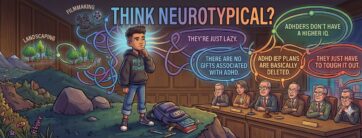
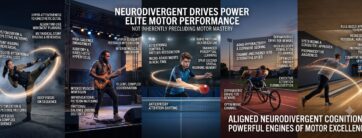
For decades, the academic consensus surrounding ADHD has been treated as a final, immutable truth: individuals with ADHD were diagnosed with poorer motor development compared to their neurotypical peers. Yet, this "consensus" is a classic example of what Dr. William Dodson describes as the hubris of an era that falsely believes it has reached the […]
Electronic Devices and The Loss of Formative Play
When a tablet becomes a primary babysitter for children between the ages of 4 and 8, the damage isn't just about "wasted time." The true crisis is opportunity cost via time theft. During this critical developmental window, the human brain relies on physical, three-dimensional exploration and real-time human feedback to wire its sensory and emotional […]
The Hubris of the Lab Bench: Why ADHD Science Needs a “Reboot”
For decades, the academic consensus surrounding ADHD has been treated as a final, immutable truth: individuals with ADHD were diagnosed with poorer motor development compared to their neurotypical peers. Yet, this "consensus" is a classic example of what Dr. William Dodson describes as the hubris of an era that falsely believes it has reached the […]
The Neurobiological Trap: Nighttime Hyperarousal and the 15-Year-Old Medication Cliff
To truly understand why neurodivergent teenagers face such severe, systemic sleep deprivation, we must look past simple behavioral choices and examine the literal neurobiology of the ADHD and ASD brain. It is not just that these teenagers want to stay up late; it is that their nervous systems are structurally and chemically wired to resist […]
Flipping the Script on Dr. Russell Barkley and Executive Functions Deficits
For decades, the mainstream medical narrative surrounding ADHD has been dominated by a single, clinical perspective: ADHD is a severe, unmitigated disability of the prefrontal cortex. The leading architect of this view, the retired Dr. Russell Barkley, gave the world an incredibly rigorous scientific map of executive function deficits—tracking how our brains struggle with working […]

Athletics

The Ladder Effect: Shifting Math Classrooms from Performance Anxiety to Experiential Flow
The reason a golf assessment of perseverance—specifically through the relentless nature of the ladders drill—successfully eliminated performance anxiety when translated to the math classroom comes down to a profound neurological and psychological shift. By taking the mechanics of that specific golf drill and embedding them into your pedagogy, you essentially rewired how the brain perceives failure, […]
When looking at how Belgium handles support for athletes with ADHD, the system is defined by a highly medicalized, localized, and divided infrastructure.
Because Belgium is politically split into distinct communities—mainly the Dutch-speaking Flemish Community (Flanders) and the French-speaking Walloon Community (Wallonia)—there is no single national blueprint. Instead, Belgium relies on a deep-rooted network of localized sports clubs, world-class adapted physical activity research, and a highly structured, rigid "Medical Prescription" model. Here is how the Belgian model supports neurodivergent athletes from […]
The Mathematics of Trust: Applying Bob Rotella’s Performance Models to the High School Math Classroom
If Bob Rotella ran a high school mathematics classroom, he would completely tear down the traditional, anxiety-inducing structure of math education. There would be no frantic cramming, no paralyzing fear of failure, and no mechanical over-thinking during exams. Instead, he would treat mathematics exactly like an elite sport, transforming the room from a place of […]
The Godfather of the “Mental Game”: Assessing Bob Rotella’s True Legacy in Sports Psychology
It is highly accurate to call Dr. Bob Rotella the "godfather" of applied sports psychology and how it is popularized across sports today—but in the broader history of psychology, he is more accurately the master of the "mental game" translation rather than the father of the scientific discipline itself. To map out where he truly stands, it […]
A Place to Belong: Why Norway Views the Sports Club as the Ultimate ADHD Intervention
When looking at how Norway approaches support for athletes with ADHD, the model shifts away from the elite-centric talent optimization of Brazil and the bureaucratic risk-mitigation of the US. Instead, Norway relies on its famous "Idrett for alle" (Sport for All) egalitarian framework, combined with massive, data-driven public health integration. Norway treats organized sports not merely as recreation or […]
The Hyperfocus Edge: What US Classrooms Can Learn from Brazilian Sports Psychology
When looking at how Brazil approaches support for athletes with Attention Deficit Hyperactivity Disorder (ADHD), the landscape spans strict anti-doping regulations, high-performance coaching, and a deep cultural reliance on highly structured sports like Brazilian Jiu-Jitsu (BJJ) as therapeutic frameworks. But the most revolutionary element of the Brazilian model lies in its elite soccer academies. While […]
Channelling Hyperfocus: How Brazil Navigates Anti-Doping and Support for World Cup Athletes with ADHD
When looking at how Brazil approaches support for athletes with Attention Deficit Hyperactivity Disorder (ADHD), the landscape spans strict anti-doping regulations, high-performance coaching, and a deep cultural reliance on highly structured sports like Brazilian Jiu-Jitsu (BJJ) as therapeutic frameworks. Here is a breakdown of how the intersection of neurodiversity and athletics functions in Brazil today. […]
John Chaney: A Model Mensch for Teachers of ADHDers in the Classroom
In college athletics, coaches are routinely judged by a ruthless calculus: wins, tournament appearances, and graduation rates. But the late, legendary Temple University basketball coach John Chaney operated on a different plane entirely. To Chaney, a basketball court wasn't just an arena for sport; it was a classroom, a sanctuary, and—most importantly—the home of a […]
ADHD: The Necessity of Showing Rather Than Telling
The necessity of showing rather than telling is a foundational concept when collaborating with, coaching, or leading individuals with ADHD. Because abstract verbal instructions require a high degree of mental sequencing and working memory, concrete visual examples act as a cognitive bridge. The dynamics of this approach are illustrated by the basketball examples, the bakery analogy, and […]

Our Advocates

Joseph Sisko

Creative Director and ADHD Advocate

Dr William Dodson

ADHD Mental Health Advocate

Maryann Theadora

Leed Empath

Benjamin Sisko

Defiant Captain

Legal & Educational Disclaimer

1. Educational and Informational Purposes Only The content provided on this website—including articles, frameworks, graphics, podcast episodes, and apparel concepts—is for informational, educational, and advocacy purposes only. It is intended to highlight alternative learning insights and neurodivergent potential. It is not a substitute for professional medical or psychological advice, diagnosis, or treatment.

2. Anecdotal Evidence and Comorbidities The personal stories, field experiences, and strategies shared here represent anecdotal evidence showcasing the potential of individuals with ADHD, AuDHD, and ASD. These accounts are presented without any warranty or guarantee of specific outcomes. Because the behavioral science profession frequently navigates a multitude of complex, underdiagnosed comorbidities, what works for one individual may not apply to another.

3. No Professional Relationship Your use of this website, or your interaction with any associated materials, does not create a professional-client, therapist-patient, or advisory relationship.

4. Seek Professional Advice Always seek the advice of your physician, licensed therapist, or other qualified healthcare provider with any questions you may have regarding a medical or mental health condition. Never disregard professional medical advice or delay in seeking it because of something you have read on this platform.

5. Limitation of Liability By utilizing the information, concepts, or tools discussed on this website, you voluntarily agree that you are doing so at your own risk. The creators and affiliates of this platform assume no responsibility or liability for any consequence resulting directly or indirectly from any action or inaction you take based on the information provided.

6. Crisis Notice This website is not a crisis monitoring resource. If you or someone you know is struggling with a mental health crisis, please contact your local emergency services (such as dialing 988 or 911 in the U.S.) or go to the nearest emergency room immediately.